
7 Smart Home Gadgets Interior Designers Are Quietly Adding to Luxury Homes in 2026
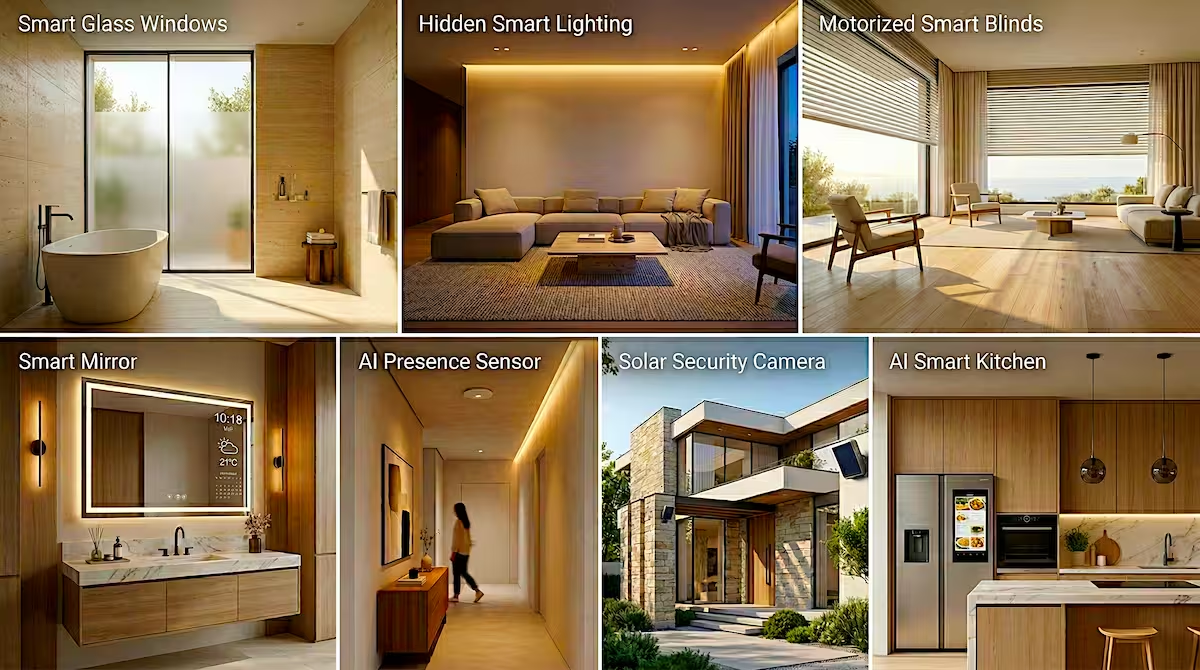
In 2026, the smartest homes do not look smart at all. Therefore, the best smart home gadgets blend invisibly into architecture and they are redefining luxury living entirely.
In this article, you will discover:
- Why interior designers choose hidden tech over visible gadgets
- 7 smart home gadgets now standard in luxury homes
- Brand recommendations and real cost ranges
- Which rooms benefit most from each upgrade
- How these gadgets save energy and increase property value
According to the International Energy Agency, smart home technologies are among the fastest-growing tools for residential comfort and energy efficiency. Consequently, these seven upgrades are now at the top of every luxury designer’s specification list.
1. Smart Glass Windows for Instant Privacy
What Is Smart Glass?
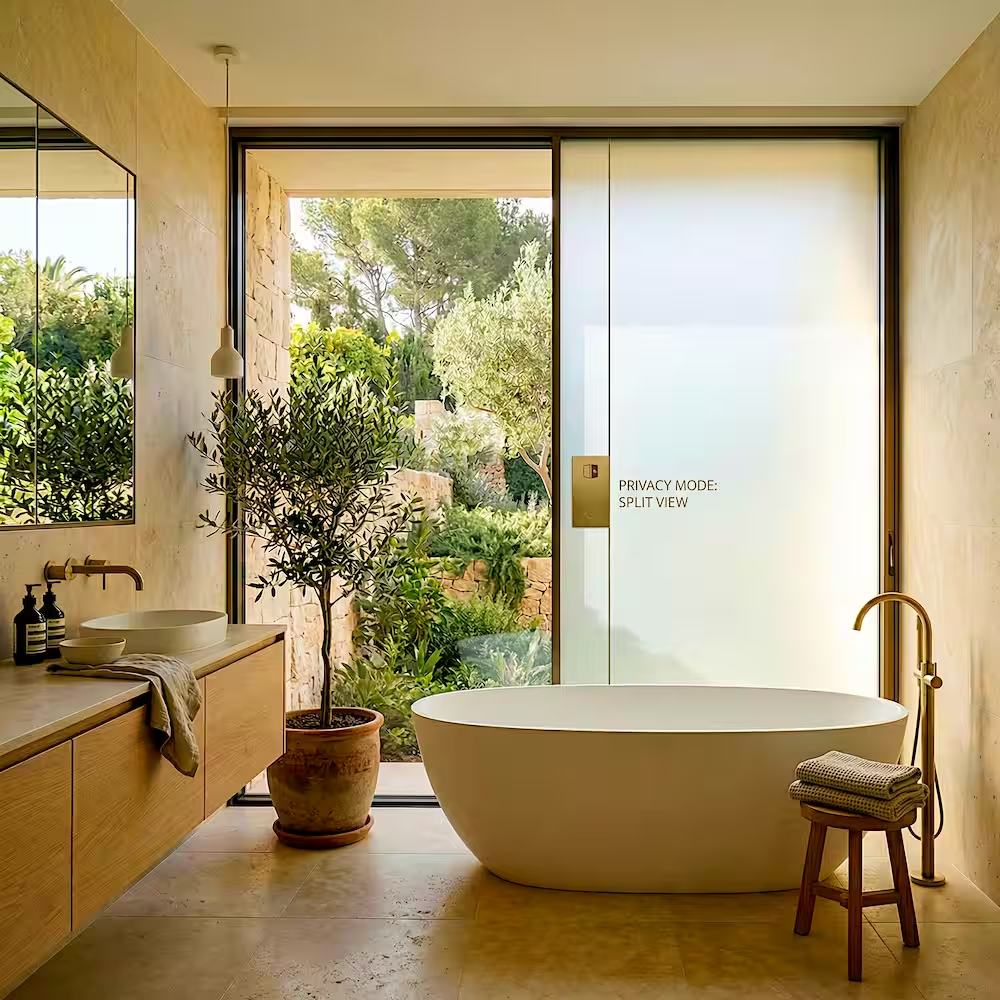
Smart glass switches from fully transparent to completely frosted at the touch of a button or on an automated schedule. Therefore, homeowners enjoy natural light without sacrificing privacy and without a single curtain or blind.
Why Designers Specify It
Interior designers across the US and Europe are quietly specifying smart glass in high-end bathrooms and home offices. Furthermore, according to the U.S. Department of Energy, dynamic glass technologies regulate indoor temperatures by controlling solar heat gain delivering real energy savings alongside aesthetic benefits.
Key Benefits
- Preserves open architecture while providing complete privacy control
- Eliminates the need for window treatments entirely
- Improves natural light distribution throughout the day
- Creates a minimal, uncluttered contemporary aesthetic
- Reduces HVAC load by managing solar heat gain
Best Locations for Smart Glass
| Location | Why It Works | Top Brands |
|---|---|---|
| Luxury bathrooms | Instant privacy without blocking light | Smartglass International, Pilkington |
| Home offices | Reduce distractions while keeping daylight | View Glass, SageGlass |
| Glass partition walls | Maintain openness with visual control | Gauzy, Prism Solar |
2. Hidden Smart Lighting Systems
What Is Hidden Smart Lighting?
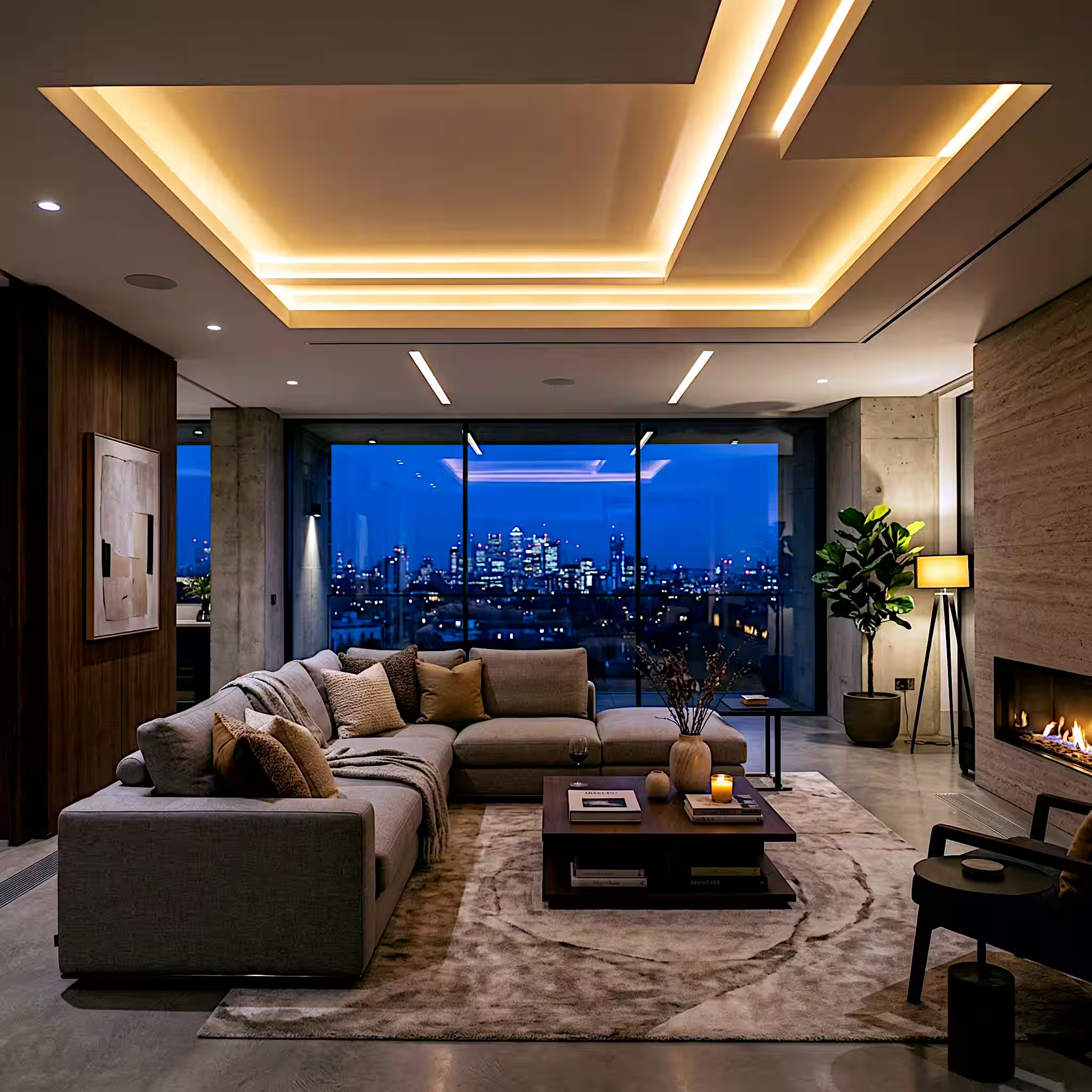
Instead of visible fixtures, designers install concealed LED systems within ceilings, walls and cabinetry. As a result, lighting becomes an invisible architectural feature rather than a decorative addition.
Why It Matters for Health and Design
Throughout the day, these systems automatically shift brightness and color temperature to match natural daylight cycles. Moreover, research from Harvard Medical School confirms that balanced lighting environments directly support healthier sleep and improved daytime productivity making this upgrade far more than a style choice.
Key Benefits
- Automatic brightness and color temperature adjustment
- Circadian-rhythm-friendly lighting schedules
- Energy-efficient LED technology with up to 80% savings
- Voice and app control via Alexa, Google Home and Apple HomeKit
- Mood-based scenes for dining, cinema, reading and entertaining
Most Popular Installation Zones
| Room | Lighting Style | Recommended Brands |
|---|---|---|
| Living rooms | Cove and accent lighting | Lutron Caséta, Philips Hue |
| Kitchens | Under-cabinet and toe-kick lighting | Kichler, LIFX |
| Bedrooms | Warm ambient ceiling wash | Nanoleaf, Legrand |
| Hallways | Motion-activated path lighting | Lutron, Insteon |
3. Motorized Smart Blinds

What Are Motorized Smart Blinds?
Motorized smart blinds open and close automatically on a programmed schedule or via voice command. Consequently, homeowners wake up to natural daylight and stay cool in the afternoon with zero manual effort.
Why Designers Install Them
Automated blinds are consistently the most requested smart home gadget in luxury residential projects. In addition, they protect expensive furniture and flooring from UV damage and integrate with whole-home energy management platforms across Europe and North America.
Key Benefits
- Fully scheduled operation wake up to natural light automatically
- Compatible with Alexa, Google Assistant, Apple HomeKit and SmartThings
- Protects hardwood floors, artwork and upholstery from UV damage
- Improves bedroom sleep quality by eliminating light pollution
- Reduces cooling costs in summer by managing solar heat gain
Designer Installation Guide
| Room | Design Advantage | Top Brands |
|---|---|---|
| Living rooms | Maintains panoramic views on demand | Somfy, Lutron Sivoia |
| Bedrooms | Blackout functionality for better sleep | Hunter Douglas, IKEA Fyrtur |
| Dining areas | Glare control during daytime meals | Serena by Lutron, MySmartBlinds |
4. Smart Mirrors in Bathrooms and Dressing Areas
What Is a Smart Mirror?
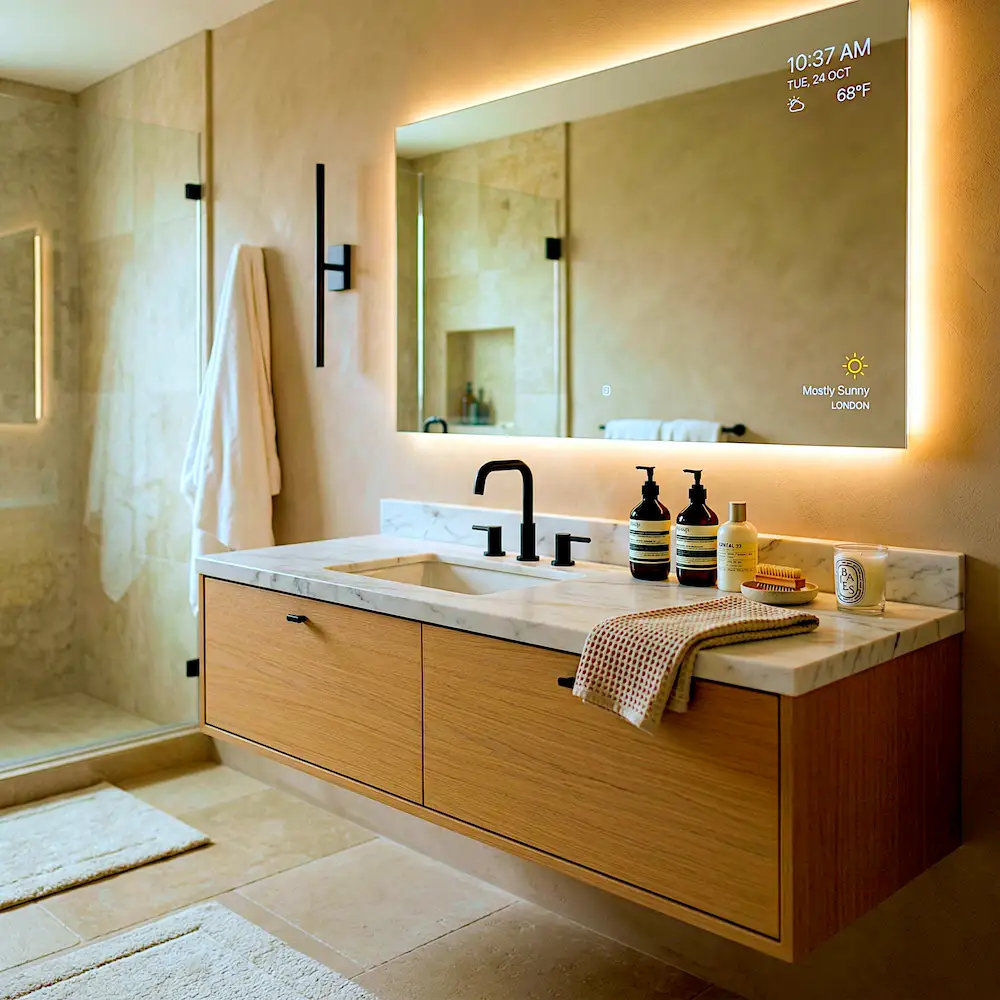
A smart mirror looks completely normal at first glance. However, when activated, a subtle display appears showing weather updates, calendar reminders and lighting controls directly on the glass surface.
Why Homeowners Love Them
Furthermore, built-in LED lighting provides adjustable illumination for grooming and anti-fog technology keeps the surface clear after showers. Many models now connect with fitness apps and health platforms, making mornings measurably more efficient.
Key Features
- Adjustable built-in LED lighting with color temperature control
- Anti-fog coating activated automatically after hot showers
- Touchscreen display for weather, calendar and smart home controls
- Voice assistant integration Alexa and Google Assistant compatible
- Bluetooth speaker functionality for audio
Best Spaces for Smart Mirrors
| Location | Use Case | Recommended Models |
|---|---|---|
| Bathroom vanity | Morning routine efficiency | Kohler Verdera, Simplehuman Sensor |
| Walk-in wardrobe | Full-length outfit review | Electric Mirror, Séura |
| Home gym | Fitness tracking and workout display | Mirror by Lululemon, Tempo |
5. AI Presence Sensors for Automatic Living
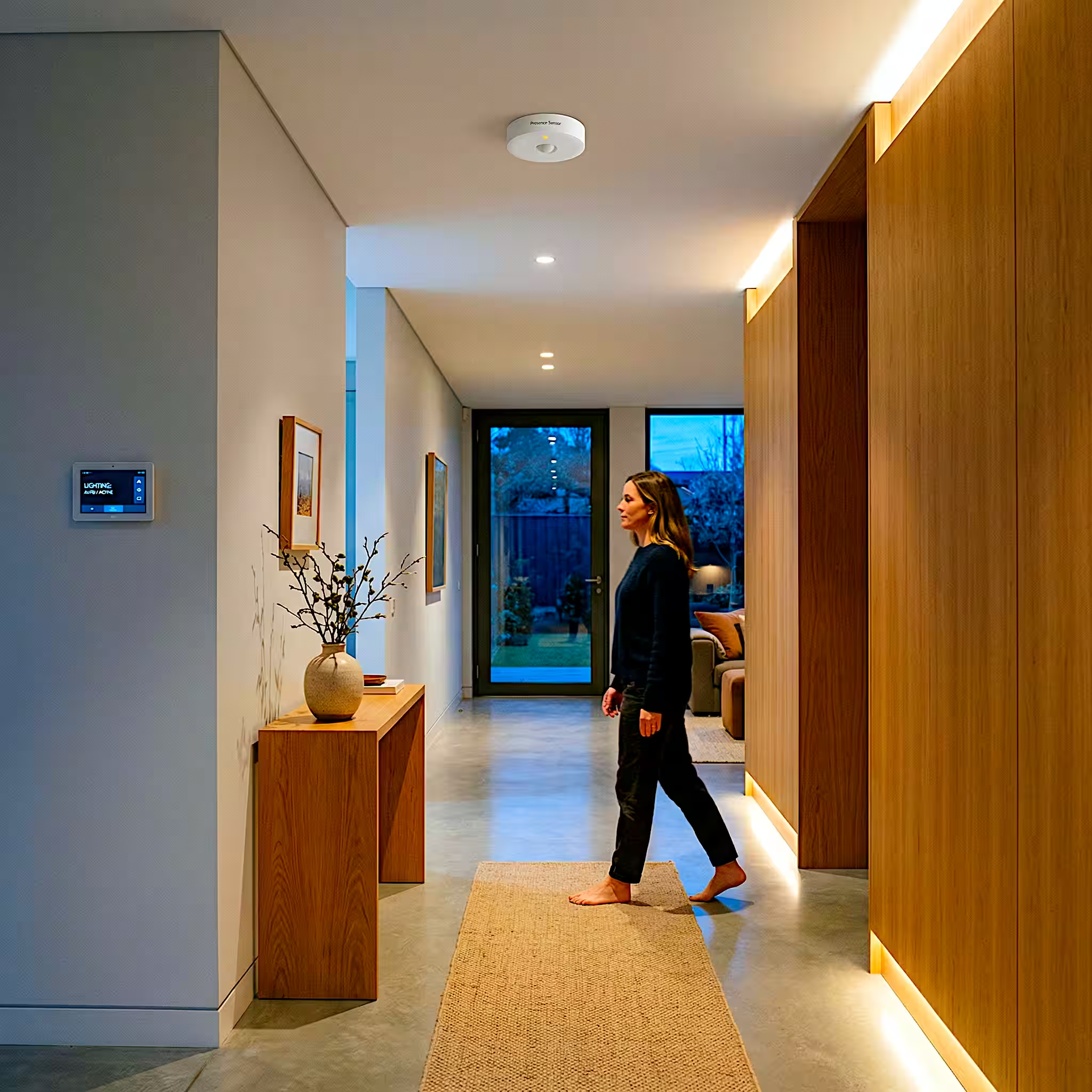
What Is an AI Presence Sensor?
Unlike basic motion sensors, AI presence sensors use millimeter-wave radar to detect occupancy and behavioral patterns. Therefore, the home responds automatically lights activate, thermostats adjust and music follows room by room.
Why Designers Are Specifying Them
These sensors are quickly becoming standard in new luxury builds across the US, UK and Scandinavia. As a result, homeowners no longer need to manually adjust devices. Instead, the home adapts intelligently to whoever is inside.
What AI Presence Sensors Can Control
- Smart lighting — instant activation, delayed off timers by zone
- Heating and cooling — zone-based HVAC optimization
- Home entertainment systems — automatic audio and display activation
- Security alerts — distinguishes between occupants and intruders
- Energy reporting — tracks real-time room-by-room consumption
Performance Comparison
| Feature | Basic Motion Sensor | AI Presence Sensor |
|---|---|---|
| Detection accuracy | Movement only | Presence + behavioral pattern |
| Multi-person tracking | Not available | Detects multiple occupants |
| Energy savings | Moderate | Up to 40% lighting reduction |
| Top brands | — | Aqara FP2, Presence by Eve, Tuya |
6. Solar-Powered Security Cameras
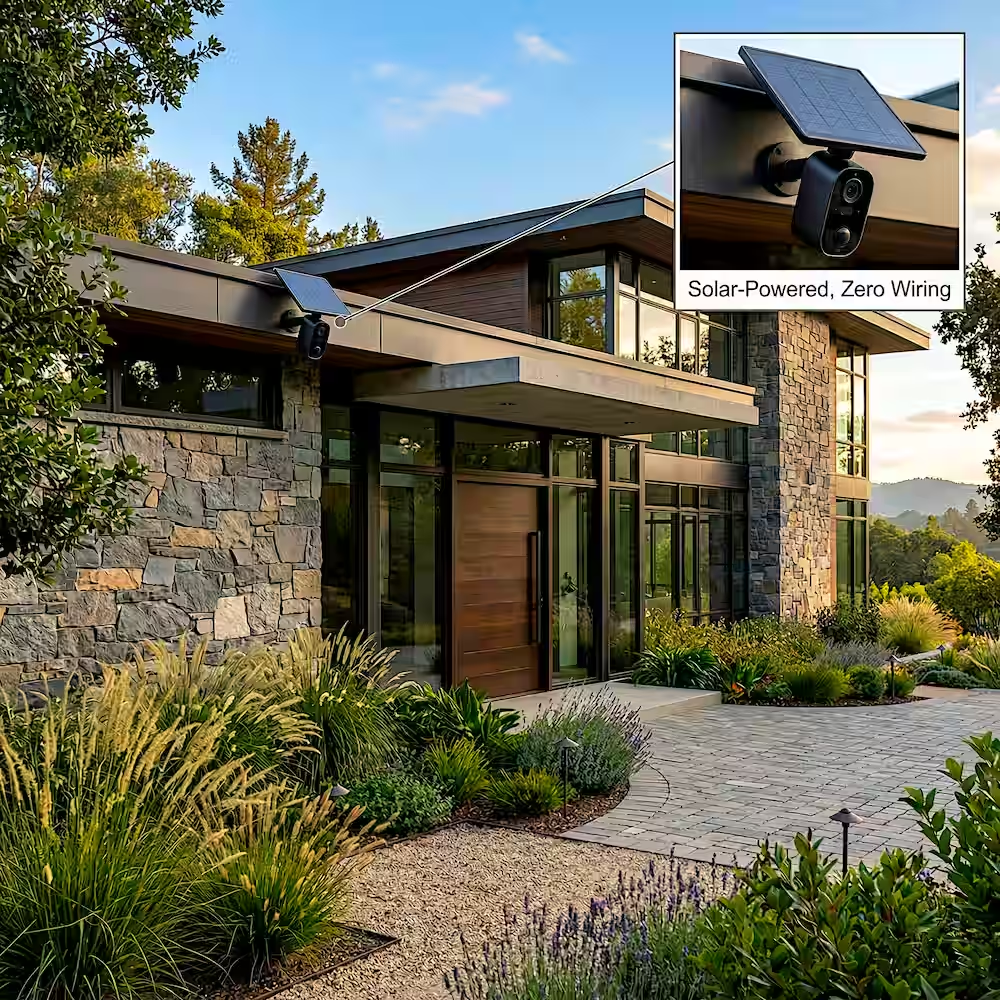
What Are Solar Security Cameras?
Solar-powered security cameras run entirely on renewable energy therefore, they require zero wiring and minimal maintenance. As a result, designers specify them widely because they preserve a home’s clean exterior appearance completely.
Why They Are Growing in Popularity
These cameras feature AI-powered motion detection that distinguishes between people, vehicles and animals. Furthermore, live footage streams directly to mobile apps and most models include two-way audio for real-time communication. Because they use renewable energy, they also align perfectly with sustainable luxury design trends expanding across Europe and North America.
Key Advantages
- Completely wireless no drilling, no cabling, no electrician required
- AI-powered motion detection with person and vehicle classification
- Color night vision with infrared backup
- Two-way audio for real-time communication
- 100% renewable energy operation zero electricity cost
Best Installation Locations
| Location | Security Benefit | Top Models |
|---|---|---|
| Front entrance | Facial recognition zone coverage | Ring Solar, Arlo Pro 5S Solar |
| Driveway | Vehicle approach detection | Eufy SoloCam S340, Anker |
| Garden / backyard | Wide perimeter monitoring | Reolink Argus 4 Pro, TP-Link Tapo |
7. AI Smart Kitchen Appliances
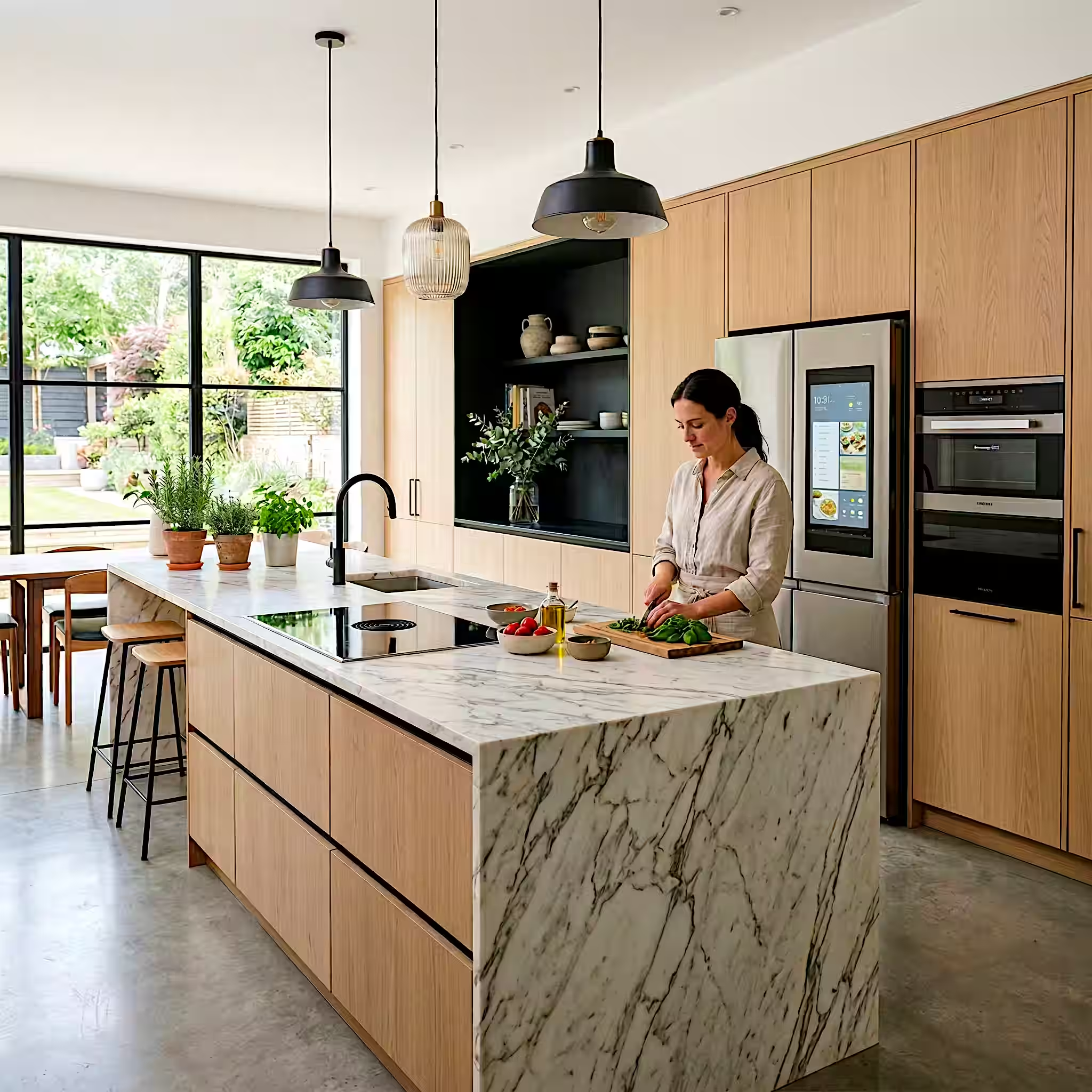
What Makes a Kitchen “AI Smart”?
AI kitchen appliances use machine learning to adapt to your habits. Consequently, smart refrigerators track groceries and suggest recipes, while AI ovens calibrate temperature and cook time automatically based on dish type and weight.
Why the Kitchen Is Becoming the Smartest Room
Furthermore, intelligent coffee machines remember personal brewing preferences for every household member and voice-controlled dishwashers optimize water usage by load size. As a result, the kitchen reduces food waste, saves time and delivers a premium experience without ever looking cluttered or technical.
Must-Have AI Kitchen Appliances in 2026
- Smart refrigerators with internal cameras and grocery tracking
- App and voice-controlled smart ovens with precision temperature AI
- Intelligent coffee machines with personalized brewing profiles
- Smart dishwashers with eco-optimized water and energy cycles
- Connected range hoods with automatic activation based on cooking sensors
Smart Kitchen Appliance Guide
| Appliance | AI Feature | Leading Brands |
|---|---|---|
| Smart refrigerator | Inventory tracking and recipe suggestions | Samsung Family Hub, LG ThinQ |
| AI oven | Auto temperature and cook time calibration | GE Profile, Tovala, Breville |
| Coffee machine | Personalized brewing memory per user | De’Longhi Dinamica Plus, Jura |
| Smart dishwasher | Load-sensing water optimization | Bosch Series 8, Miele G 7000 |
Why Interior Designers Prefer Invisible Smart Technology
The Core Design Philosophy
In 2026, the overarching principle in luxury design is this: the best technology is the technology you never see. Therefore, every gadget on this list integrates into the architecture rather than competing with it.
How It Works in Practice
Lighting disappears into ceilings. Sensors hide inside walls. Appliances slot seamlessly into cabinetry. Consequently, the home becomes more responsive, more efficient and more beautiful all at once. This is why leading designers in New York, London, Toronto and Paris are no longer asking whether to include smart home gadgets. Instead, they are asking which ones to specify.
Final Thoughts
Smart home technology in 2026 has reached a genuinely exciting milestone. The gap between cutting-edge technology and refined interior design has finally closed. These seven smart home gadgets prove that a home can be deeply intelligent without ever looking like it is trying too hard.
From solar-powered security cameras to AI kitchen appliances and hidden smart lighting systems, the homes of today are quieter, calmer and more capable than ever before. Whether you are renovating a single room or planning a complete smart home build, any one of these upgrades will deliver a meaningful improvement to your daily life.
The smartest move in luxury home design right now? Invest in technology that disappears.
Frequently Asked Questions
What is the most useful smart home gadget in 2026?
Smart lighting systems are consistently the highest-impact upgrade for most homes. They improve comfort and mood, reduce energy consumption and integrate seamlessly with virtually every other smart home platform making them the ideal starting point for any smart home project.
Are smart home gadgets energy efficient?
Yes. Most modern smart home gadgets are specifically designed to reduce energy consumption. AI presence sensors optimize heating and lighting by room. Solar cameras eliminate electricity costs entirely. Smart blinds cut cooling loads. Together, these systems can meaningfully reduce a home’s overall energy bill.
Do smart home gadgets increase property value?
In most markets, yes. Buyers in the US, UK and Canada increasingly expect smart home features as standard in premium properties. Smart lighting, automated blinds, security systems and AI kitchen appliances are now among the features real estate agents actively highlight in luxury listings.
How much does it cost to add smart home gadgets to a luxury home?
Costs vary significantly by system and brand. Entry-level smart bulbs start under $50. Motorized blinds from premium brands like Lutron range from $300 to $1,000+ per window. Full smart glass installations can run $50 to $150 per square foot. A complete AI kitchen suite from Samsung or Miele can exceed $20,000. Most homeowners begin with lighting and blinds, then expand over time.
Which brands are best for smart home gadgets?
For lighting: Lutron and Philips Hue. For blinds: Somfy and Hunter Douglas. For security cameras: Arlo and Ring. For kitchen appliances: Samsung, LG and Miele. For presence sensing: Aqara and Eve. For smart glass: SageGlass and View. Always confirm compatibility with Apple HomeKit, Google Home or Amazon Alexa before purchasing.
Recent Posts
Matter 1.5: The Smart Home Revolution Finally Arrives in 2025
Top 10 Upcoming Smart Home Gadgets of 2026 Everyone Is Waiting For