Free Outdoor & Garden Planning Tools
Three Tools, One Page Here's What Each One Does
You don’t need to use all three just start with what you’re planning right now. Each tool works independently. The Patio Size Planner helps you figure out the ideal dimensions for your outdoor patio, how much material you’ll need (with a waste buffer built in), what it’ll cost, and how many people it can comfortably seat. Pick your shape rectangle, circle, L-shape, and more and get a full breakdown in seconds.
The Garden Lighting Calculator takes your garden dimensions and tells you exactly how many fixtures you need, what wattage and lumen output to aim for, and what it’ll cost to run annually. Whether you’re going solar, mains, or battery it accounts for all three.
The Outdoor Furniture Layout Guide is for anyone who’s ever ordered a patio set only to discover it takes up the entire space. Enter your dimensions, select your furniture pieces, and the tool tells you what fits comfortably, where things get tight, and what clearances to maintain for safe, comfortable movement.
How Big Should a Patio Be?
This is probably the most common outdoor planning question and the honest answer is: it depends on how you plan to use it.
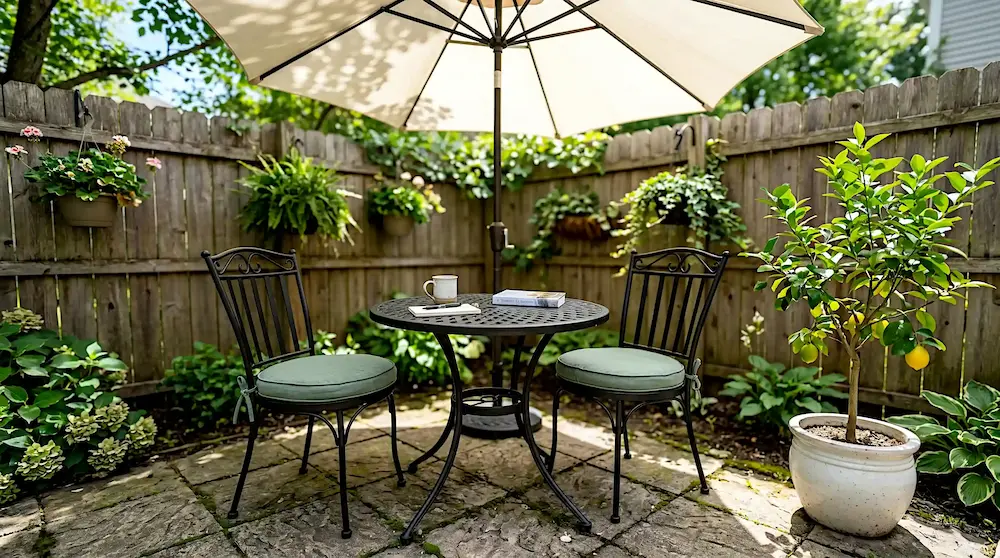
For a dining setup with four people, you’re looking at a minimum of 3m × 3m. That gives enough room for the table, chair pull-out, and comfortable movement around the sides. For six to eight guests, aim for 4m × 4m or larger.
If you’re creating a lounge area sofa, armchairs, coffee table a 3m × 4m space works well. Go larger if you want side tables or planting borders within the space.
For a combined dining and lounge area (the most popular layout for larger gardens), start at 5m × 4m and build from there. Below that, things start to feel cramped once the furniture is in.
A good general rule: your patio shouldn’t be smaller than 10–12% of your total garden area. Below that, it tends to look out of proportion with the surroundings.
Garden Lighting How Many Fixtures Do You Actually Need?
More than most people think, but fewer than most lighting catalogues would have you believe.
The standard approach used by professional landscape lighting designers is based on lux the amount of light per square metre. For a relaxed ambient garden, 20–50 lux is enough. For dramatic accent lighting, you’re looking at 50–150 lux. Security lighting sits at 150–300 lux.
In practical terms, this usually works out to one recessed spotlight per 8 m² of garden, one path light every 1.5m of pathway, and one uplight per significant tree or garden feature.
The lighting calculator above handles all of this automatically just enter your dimensions, select the zones you want to light, and it outputs a full fixture count, total wattage, and annual running cost.
One thing most people overlook the type of power source matters as much as the number of fixtures. Solar is convenient and free to run, but consistently underperforms in cloudy climates from October through March. Mains-wired lighting is the most reliable but requires a qualified electrician. Battery/low-voltage sits in the middle easy to install yourself, flexible, but adds battery replacement costs over time.
Outdoor Furniture What Actually Fits?
The biggest mistake people make with outdoor furniture is buying based on looks rather than space. A beautiful eight-seater dining set in a 4m × 4m patio leaves almost no room to move and no room for anything else.
The furniture layout tool above gives you a coverage percentage a simple number that tells you whether your space is going to feel spacious, comfortable, or overcrowded before you buy a single piece.
Some quick clearance rules worth knowing:
Allow at least 80cm behind every dining chair for pull-out and movement. Anything less and guests are squeezing past each other every time they stand up.
Keep 150cm clear around any BBQ or fire pit on all sides. This is a safety requirement, not just a comfort preference.
Your main walkway through the space from the door to the seating area should be at least 90–120cm wide. Never block it with furniture.
Leave a 30–60cm border between the edge of your patio and the nearest piece of furniture. It gives the space a finished look and stops the whole thing feeling like a furniture showroom.
- Frequently Asked Questions
What is the standard patio size for a family garden?
Most family patios in the UK and US fall between 12–25 m². For a family of four with a dining table and a small lounge area, 16–20 m² is a comfortable target. The patio size planner above gives you a personalised recommendation based on your specific dimensions and intended use.
How many garden lights do I need for a 50 m² garden?
For a 50 m² garden with ambient lighting at 30 lux, you’d need roughly 6–8 spotlights for the main areas, plus path lights every 1.5m if you have pathways, and uplights for any significant trees or features. The garden lighting calculator gives you an exact count based on your garden’s layout and the zones you want to illuminate.
Can I arrange outdoor furniture myself without a designer?
Absolutely. The most important thing is to know your clearances before you buy and that’s exactly what the furniture layout guide does. Enter your space dimensions, select the pieces you’re considering, and you’ll see the coverage percentage and a full assessment of what fits and what doesn’t.
What is the cheapest patio material?
Gravel and pebble is the most budget-friendly option at roughly $15–$50 per m² including installation. Concrete pavers are the next step up at $40–$120 per m², offering much more durability and a more finished look. Natural stone is the premium choice at $80–$250 per m².
Do I need planning permission for a garden patio?
In most countries, a ground-level patio doesn’t require planning permission as long as it doesn’t cover more than 50% of the total garden area. Rules vary by location though always check with your local council or planning authority for larger projects or if you’re close to a boundary.
Recent Posts
How to Hang Heavy Art Without Drilling Holes
Beginner Decorating Mistakes That Age a Room Fast
Should You Decorate Before Selling Your House?