15 Dark Bathroom Ideas Designers Actually Use
Written by: M. Yazdaan, Home Decor Editor
Reviewed by: Emma Cartel, Research & Editorial Standards Coordinator (ABOUT US)
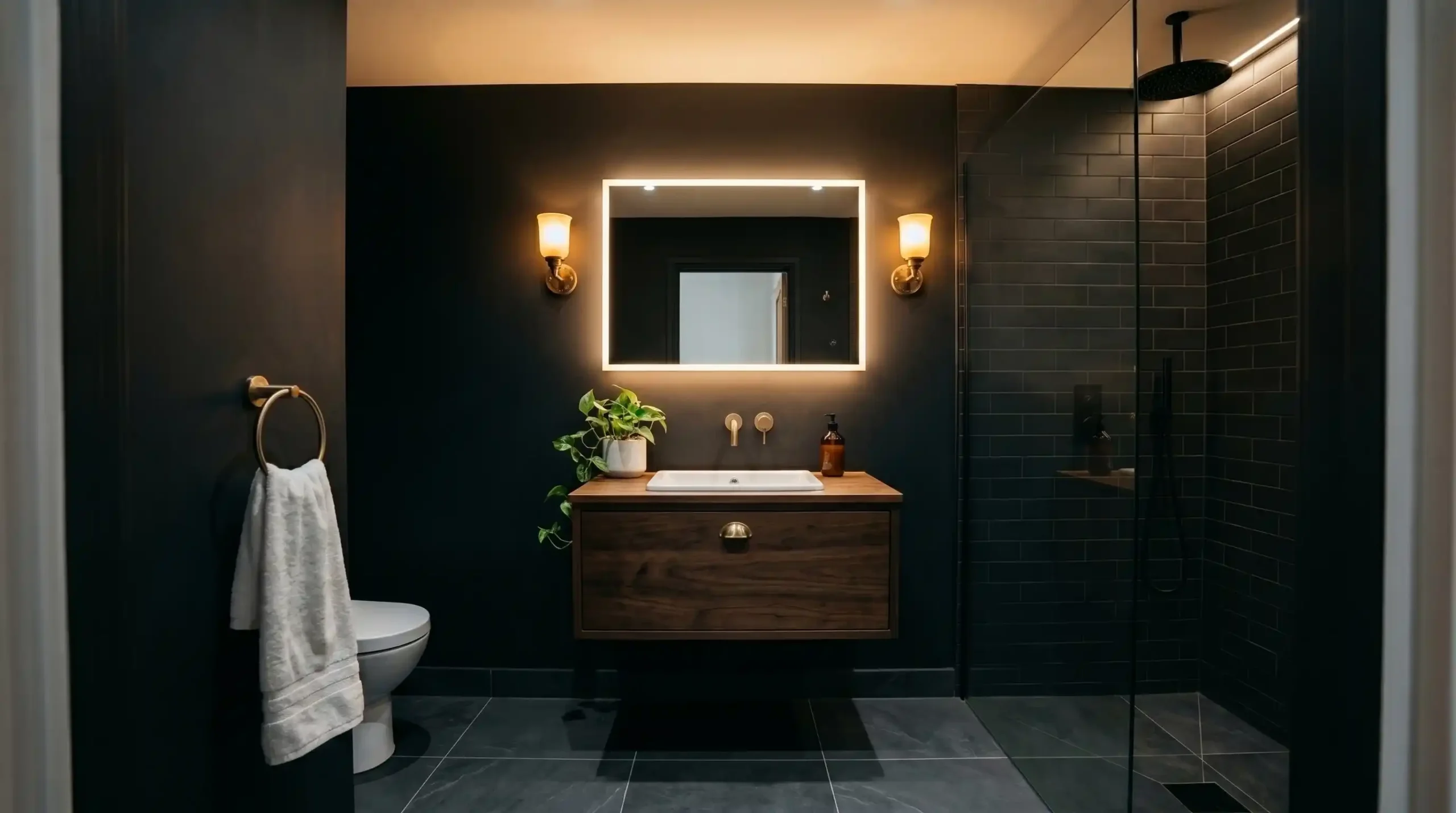
Most people avoid dark colors in bathrooms for one reason. They assume the room will feel like a cave. That fear makes sense on paper, but it almost always turns out to be wrong. A well-planned dark bathroom feels intentional, calm, and genuinely luxurious. No amount of white tile can replicate that quality.
These 15 dark bathroom ideas cover everything from a single moody accent wall to full black tile schemes. Whether you have a compact apartment bathroom or a generous master suite, several of these will work for you. At least a handful will fit your situation right now. By the end, you will know exactly how to go dark. You will not have to sacrifice light or comfort to do it.
1. Dark Paint on One Accent Wall Only
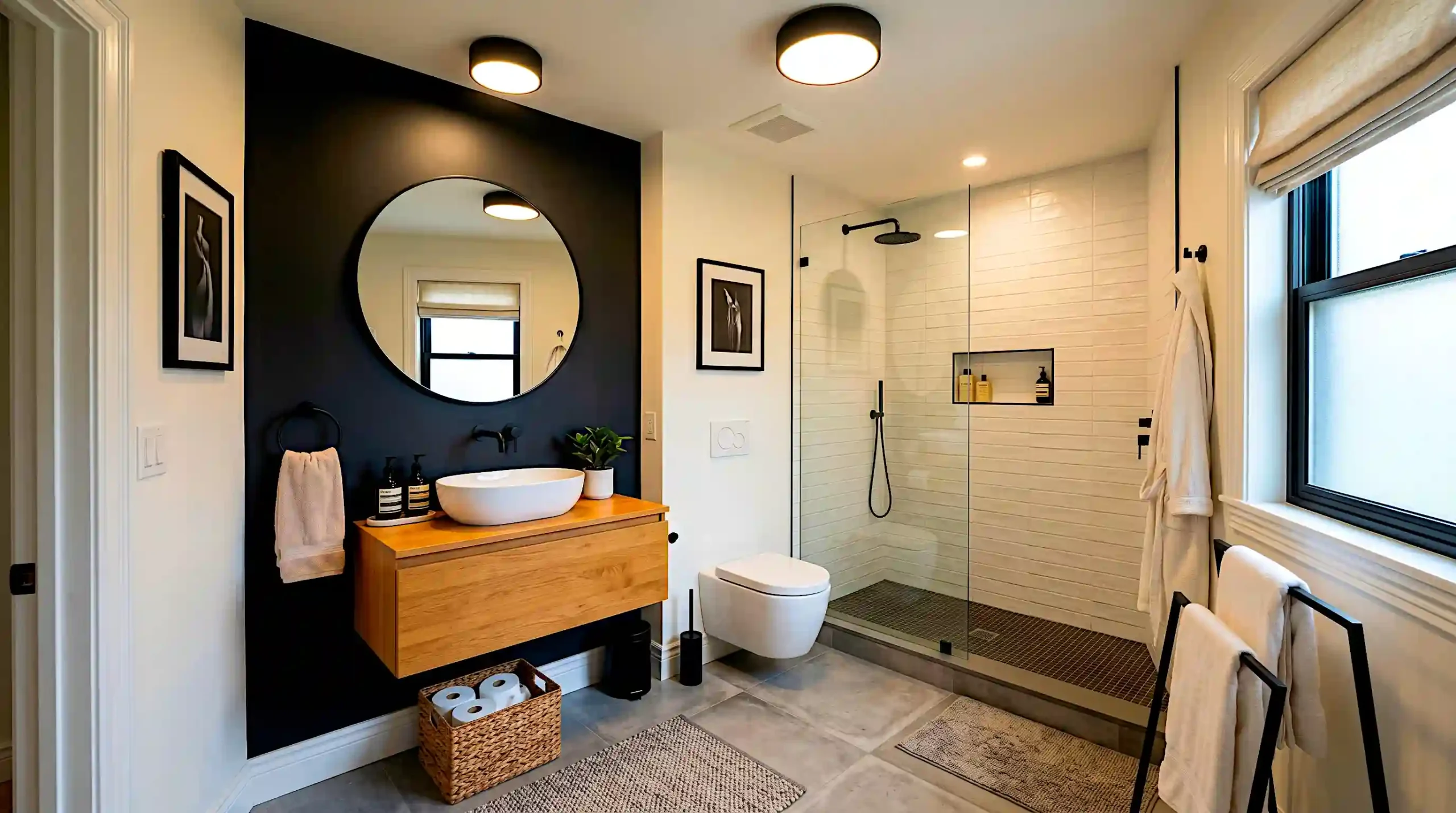
The single accent wall is the easiest entry point into dark bathroom design. It delivers a surprisingly large visual effect for a very small commitment. Painting just the wall behind your vanity in a deep charcoal or near-black color instantly anchors the room. It also makes the mirror and fixtures read as intentional design choices rather than standard builder fittings.
How to Choose the Right Paint
In practice, most homeowners find that this approach works in bathrooms as small as five by seven feet. The key is keeping the remaining three walls in a warm white rather than a stark, cold white. Farrow and Ball Railings No.31 is a near-black that reads slightly warm under bathroom lighting. You can explore the full dark paint range at farrow-ball.com. Because of this warmth, it prevents the accent wall from feeling flat or harsh.
The vanity you place against this wall matters as much as the paint itself. In fact, a floating oak or walnut cabinet with visible wood grain creates contrast that makes both elements look better together. Additionally, designers always recommend pairing a dark accent wall with a round mirror rather than a rectangular one. The curved frame softens the hard edge where dark paint meets the ceiling.
Finish Matters More Than You Think
One practical detail worth knowing: apply two full coats of eggshell finish rather than matte. Bathrooms generate steam and moisture, so eggshell holds up far better over time. It still reads as a sophisticated, non-glossy surface. However, it resists peeling in humid conditions that matte paint cannot handle.
2. Black Fixtures with White Tiles
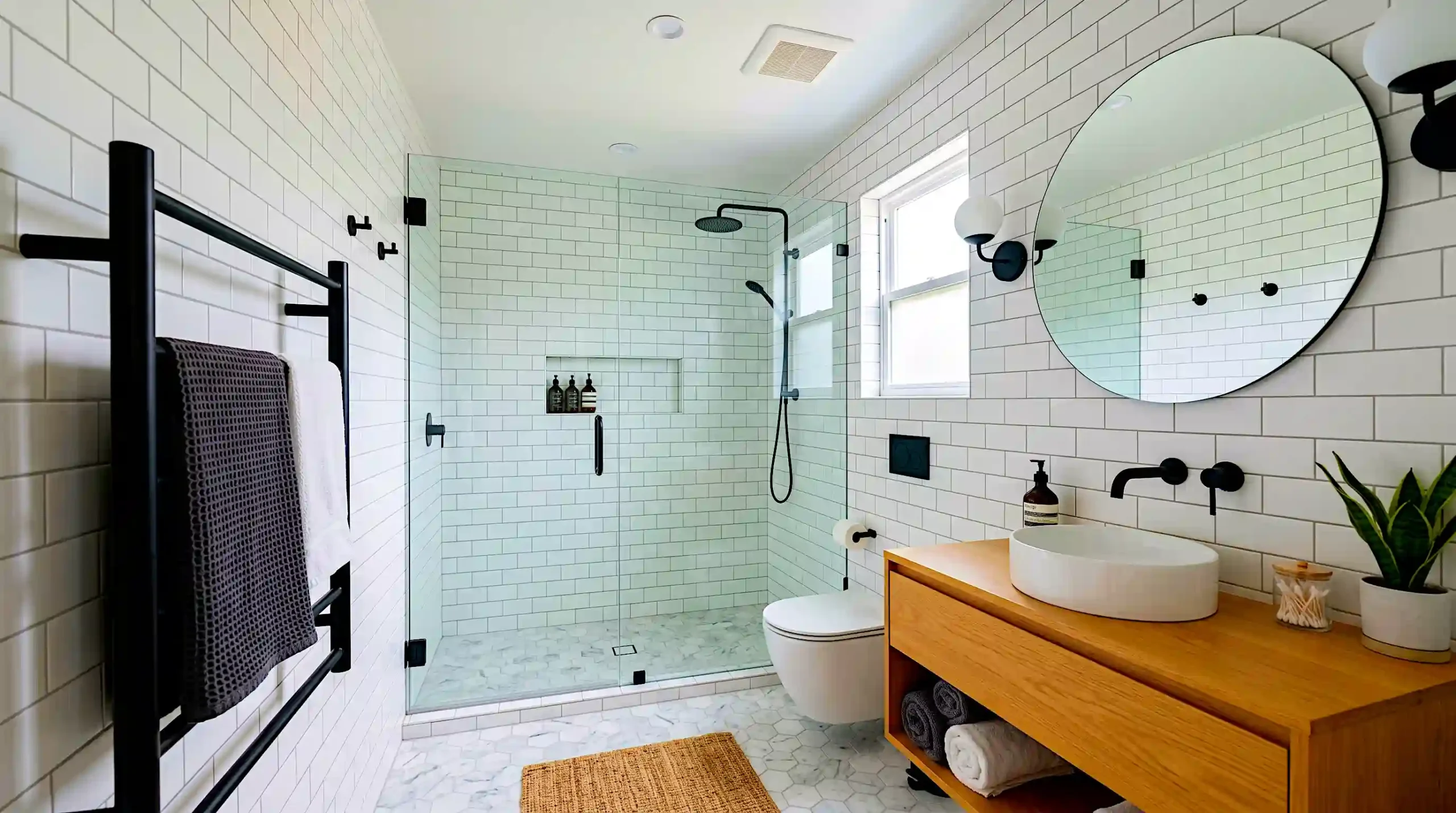
This combination sits at the intersection of timeless and current. It works because the contrast does all the heavy lifting for you. White subway tiles or white hex floor tiles create a bright, reflective base. Matte black fixtures then cut through that brightness with clean, graphic precision.
Why This Combination Works in Any Size Room
The approach works across all bathroom sizes. The tiles keep the room feeling open while the black fixtures deliver the dark, intentional quality that moody bathrooms require. Kohler’s Artifacts collection in matte black offers faucets, showerheads, towel bars, and toilet paper holders in a consistent finish. This consistency matters more than most people realize. Mixing finishes from different manufacturers produces a slightly off result that is hard to identify but easy to sense. Most homeowners only discover this problem after installation. At that point, correction means replacing every hardware piece entirely.
The Grout Decision Changes Everything
Testing across different room sizes shows that grout color makes a significant difference in this scheme. White grout keeps the room feeling bright and airy. Dark grey or charcoal grout shifts the palette toward a more industrial feel. Neither choice is wrong, but they produce genuinely different results. Decide before grouting rather than after. Changing grout color after installation is a time-consuming and expensive process. Order a small grout sample and test it against your tile in bathroom lighting before committing to the full job.
3. Deep Navy with Brass Accents
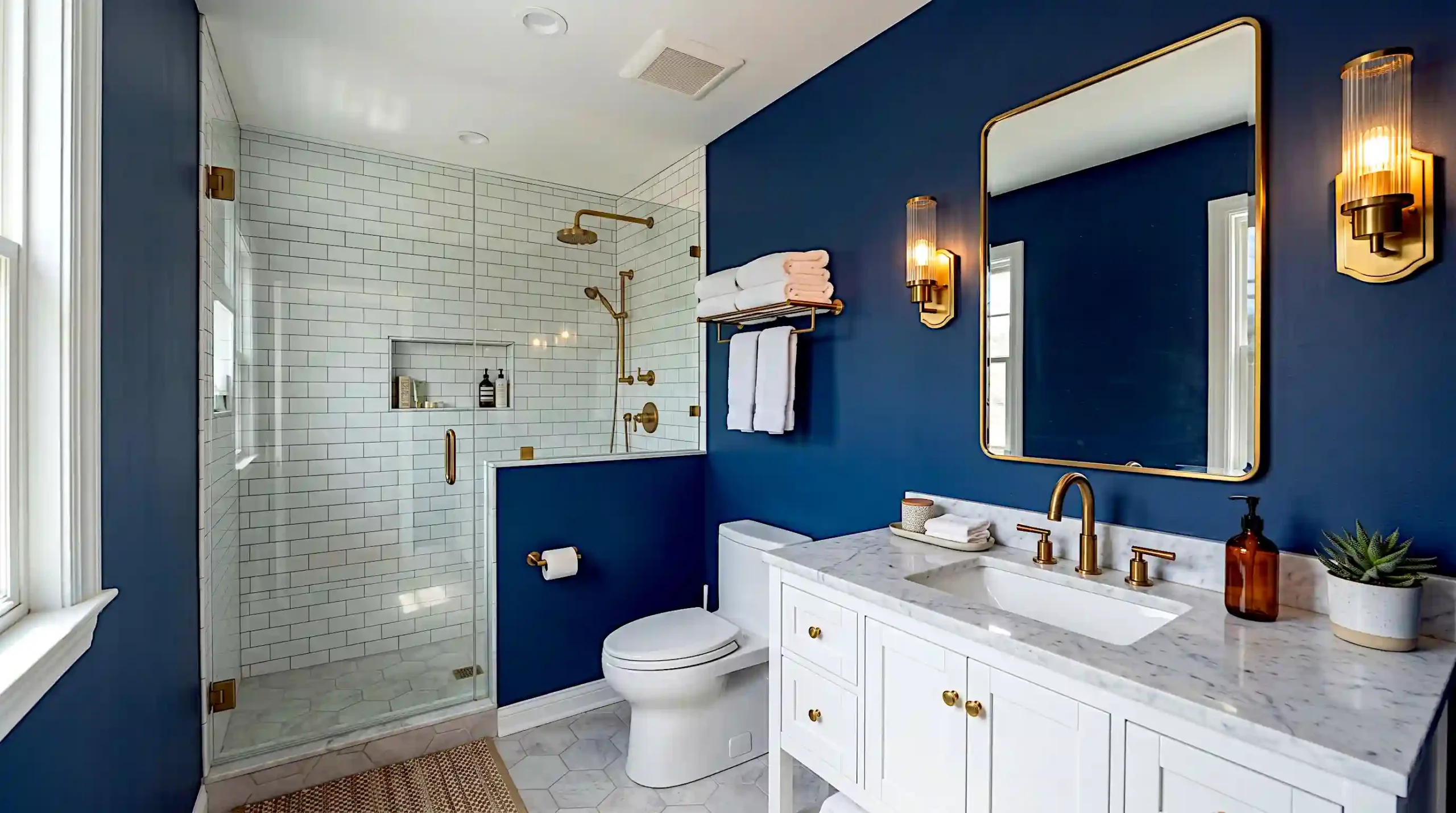
Navy is the dark color that feels least intimidating to most homeowners, and for good reason. It reads as rich and considered rather than stark. Furthermore, it carries warmth in a way that pure black and charcoal simply cannot. Pair it with unlacquered brass or antique brass fixtures. Together, deep navy and brass create a bathroom that feels closer to a boutique hotel than a typical home.
The Best Navy Paint for Bathrooms
Benjamin Moore Hale Navy HC-154 is the most always recommended navy for bathrooms among interior designers working across the USA and UK. It reads as a true navy under warm artificial light. Under cooler daylight, however, it shifts only slightly blue, which makes it reliable across different window exposures and orientations.
How to Use Brass Without Overdoing It
The brass element should appear in at least three places to feel intentional rather than accidental. Mirror frame, faucet, and towel ring form the minimum set. That said, each one reinforces the overall scheme. However, adding a brass wall sconce on either side of the mirror completes the scheme. It also solves the lighting problem that dark walls create at the same time.
Real-world experience with this palette shows that a white ceiling with navy walls prevents the room from feeling enclosed. Specifically, the ceiling acts as a visual release point. Even in a windowless navy bathroom, this white ceiling contrast keeps the space from reading as oppressive.
4. Dark Green Walls and Wood Vanity
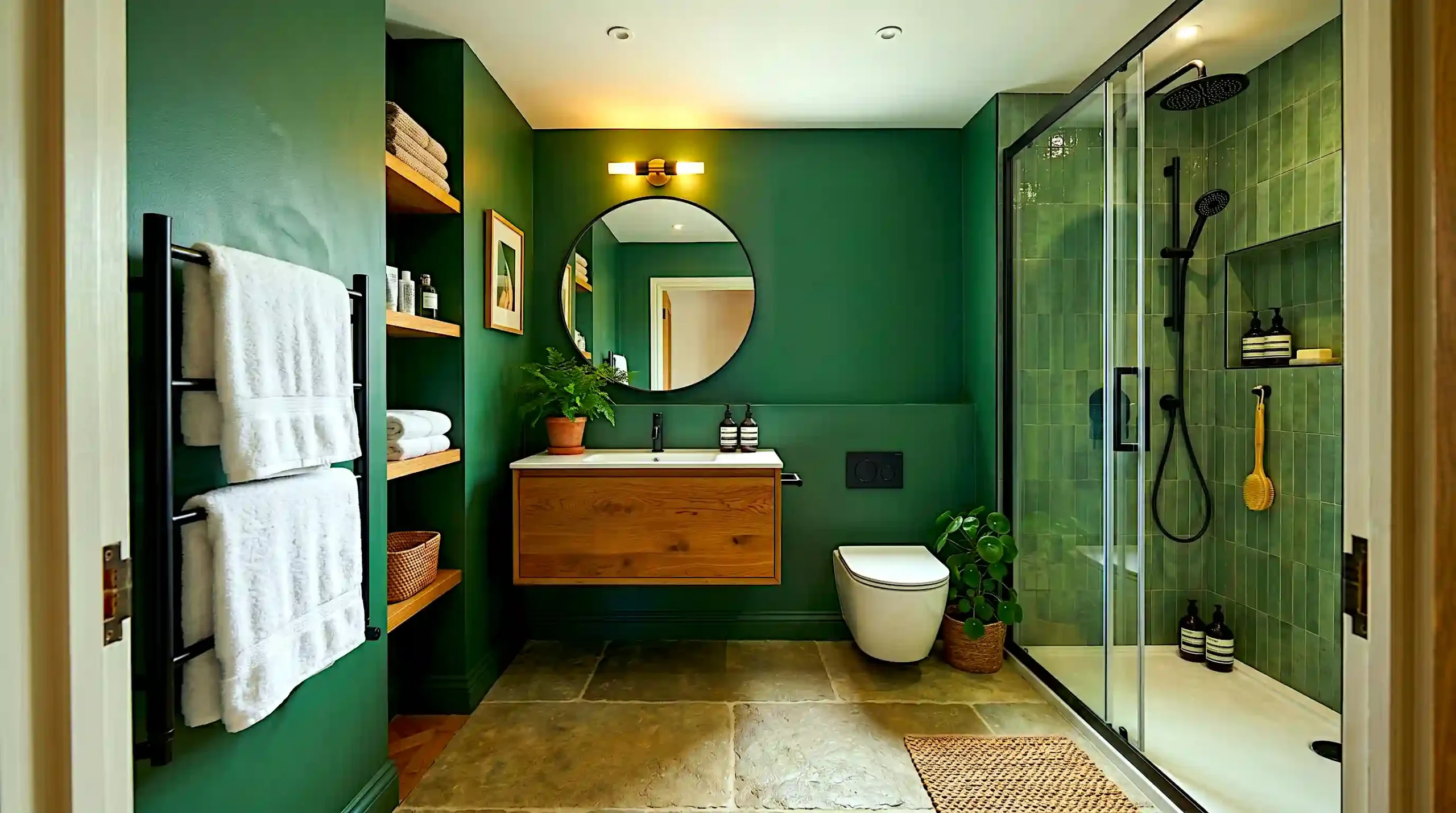
Dark green has moved firmly into mainstream bathroom design, and 2026 trend data from Sherwin-Williams confirms it shows no signs of slowing. The specific greens that work best in bathrooms sit in the forest to hunter green range. Avoid brighter, more yellow-adjacent greens in bathroom use. Sherwin-Williams Cascades SW 6477 and Farrow and Ball Studio Green No.93 are both proven performers.
Why Wood and Green Work Together
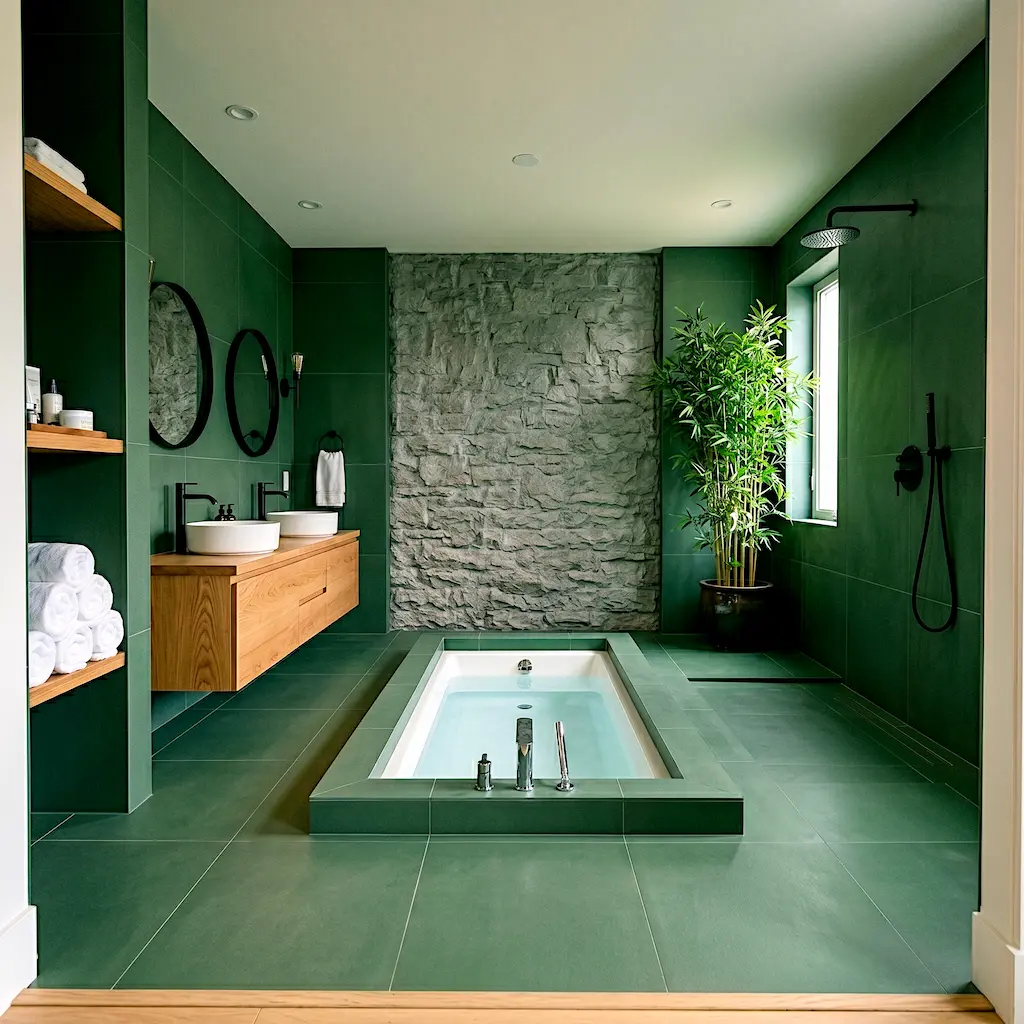
The wood vanity pairing is what elevates this combination from trend to timeless. Specifically, warm oak, walnut, or teak against dark green walls creates a connection to nature that feels genuinely restorative. This matters in bathrooms because the room functions as a reset space. As a result, materials that bring in the natural world reinforce that function in a way that purely synthetic surfaces cannot.
Hardware and Accessory Choices
Keep hardware in matte black rather than brass with this combination. Brass against dark green can feel slightly vintage, which some homeowners love and others find dated. Matte black keeps the palette contemporary and lets the green and wood carry the visual weight. Furthermore, a small potted fern or trailing pothos on the vanity corner works exceptionally well with this palette. The living plant works well here. In a room that already uses nature as its color guide, it creates a coherent sensory environment.
5. Charcoal Gray and Mirrors Strategy
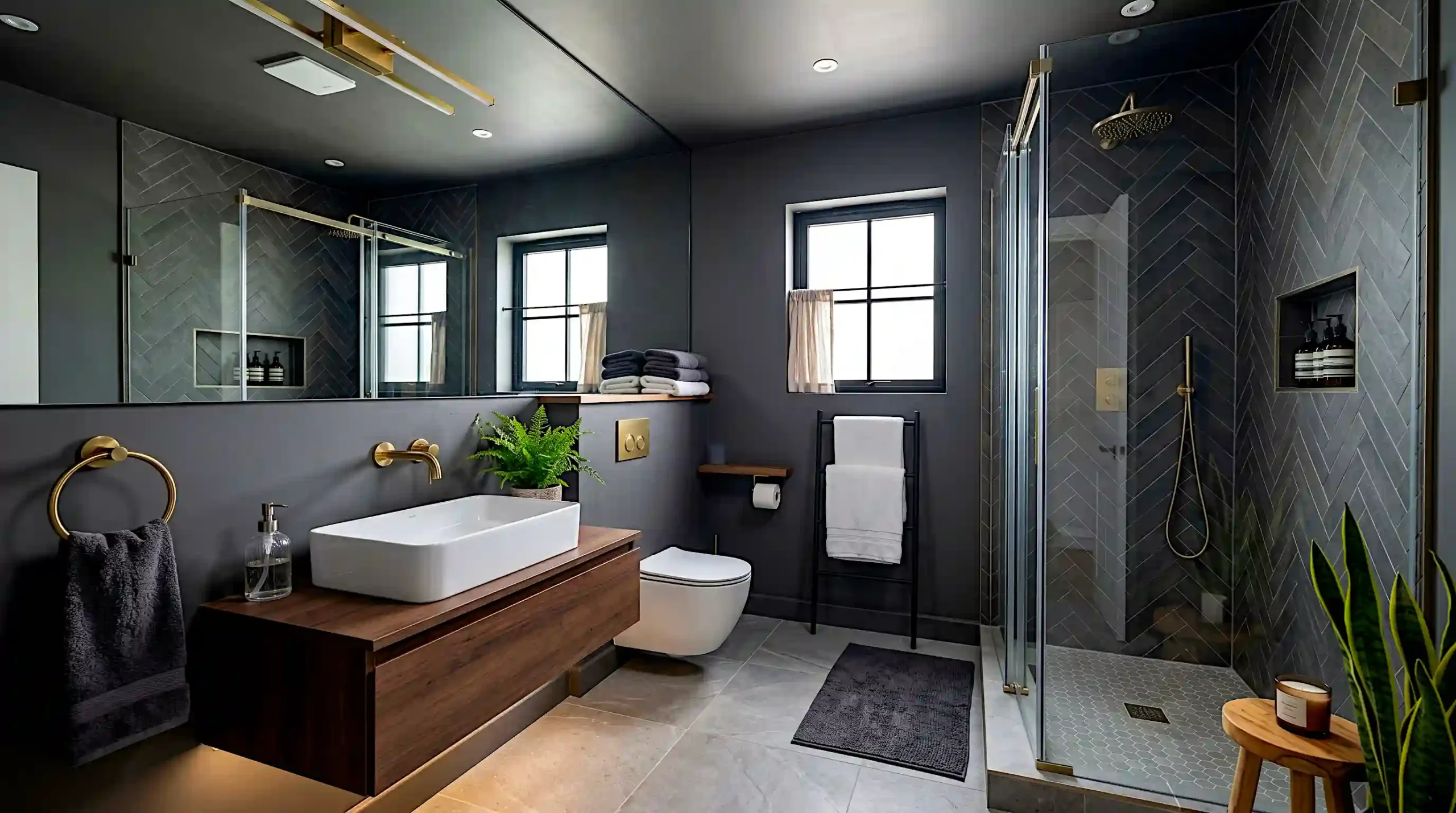
Charcoal gray is the most forgiving dark color in bathroom design. It reads as neutral rather than saturated. As a result, it does not compete with towel colors, bath accessories, or flooring the way navy or green can. What charcoal lacks in personality, it makes up for in versatility.
The Full-Wall Mirror Approach
The mirror strategy here is specific and worth understanding properly. Place a large mirror on one full wall of a charcoal bathroom. Floor to ceiling works best. The result is a room that looks significantly larger than it actually is. The reflection doubles the apparent depth of the room. It also bounces natural and artificial light back into the space. In short, it does double duty. So the mirror works twice as hard as any other element in the room.
Designers always recommend frameless mirrors for this approach rather than framed options. The reason is simple: a frame interrupts the reflection and breaks the visual illusion. A frameless mirror installed flush to the wall reads almost as an extension of the room itself. That is precisely the effect you want. In a small dark bathroom, it makes all the difference.
Product Options at Two Price Points
Robern manufactures frameless medicine cabinet mirrors in custom sizes up to 60 inches wide. For a more budget-conscious approach, IKEA’s Hovet mirror at 23 by 77 inches can be installed in a vertical column configuration. This achieves a similar effect at a fraction of the cost.
6. Dark Moody Wallpaper in Powder Room
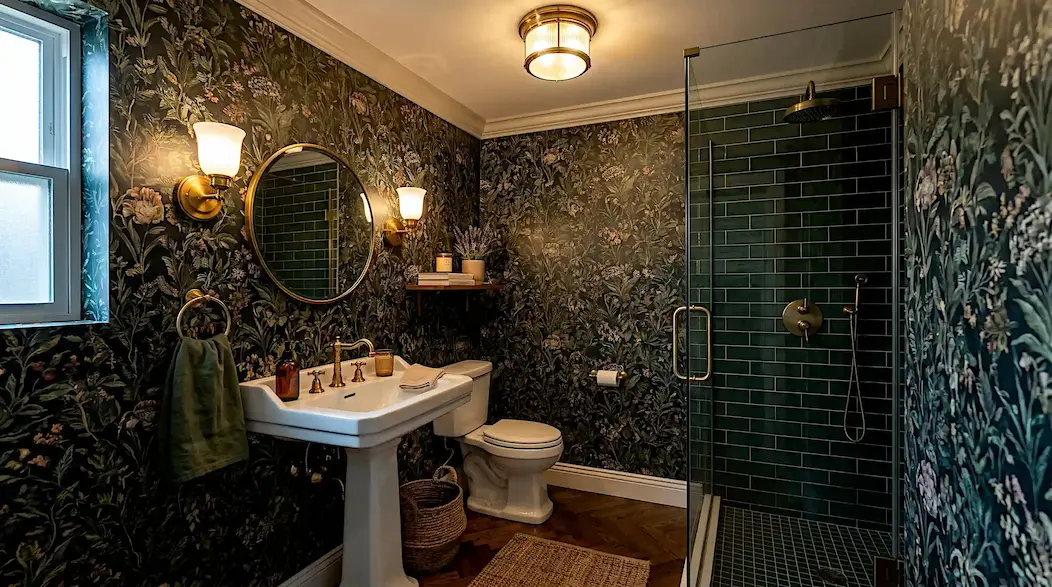
The powder room is the single best room in a home to take a design risk. Dark moody wallpaper is the risk that pays off most consistently. Because powder rooms are small and used briefly, they tolerate dramatic choices that would feel exhausting in a bedroom or living room.
Choosing the Right Dark Wallpaper
Dark botanical wallpaper with a black or deep green background creates an atmosphere that surprises guests in the best possible way. Cole and Son’s Botanical Botanica collection and Hygge and West’s dark floral patterns both offer options that photograph beautifully. Moreover, both hold up to bathroom humidity when applied with the correct adhesive and a proper vapor barrier behind them.
Keeping Fixtures Simple
The fixtures in a wallpapered powder room should be simple and unfussy. A white pedestal sink, unlacquered brass faucet, and a single round brass-framed mirror let the wallpaper command the room without competition. A pendant light with a small amber glass shade adds to the intimate mood. It works far better than a standard ceiling fixture in a wallpapered room.
Installation Is Everything
In practice, installation is the most common failure point with dark bathroom wallpaper. Hiring a professional wallpaper installer rather than attempting a DIY use almost always produces a better result. Seam alignment problems in tight, humid rooms are difficult to fix after the fact. Consequently, they immediately undermine the look you are trying to achieve.
7. Black Subway Tiles with Grout Contrast
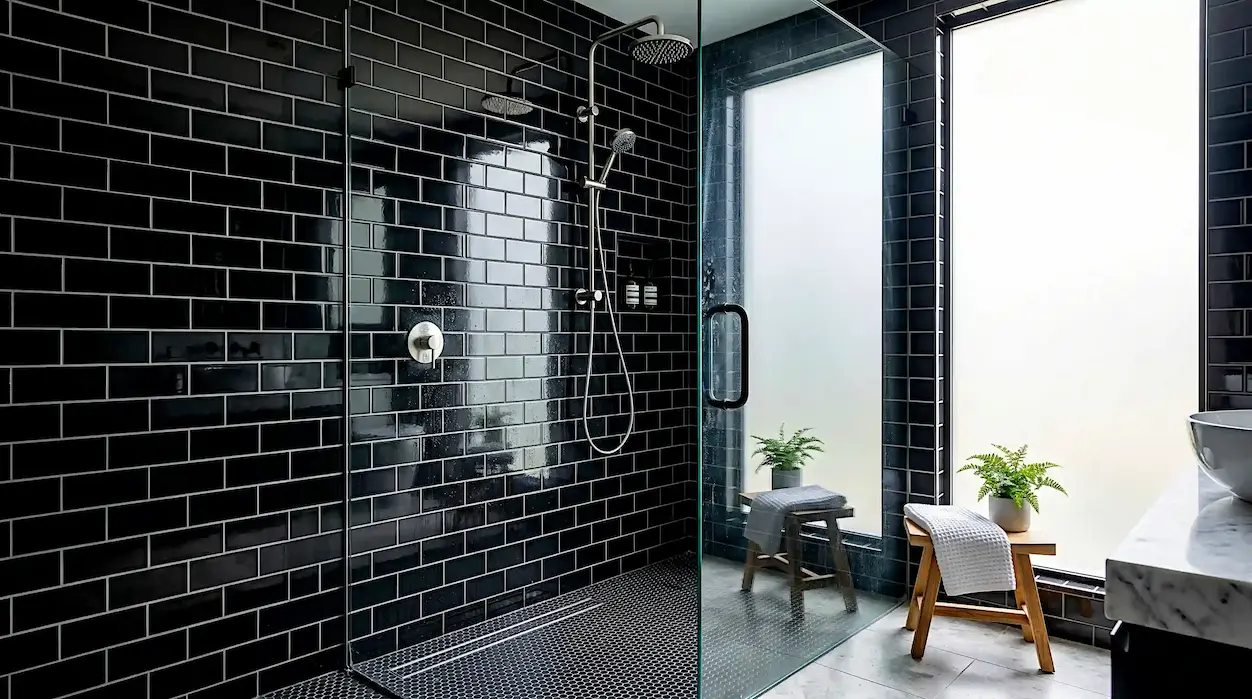
Black subway tiles work differently from dark paint. They introduce texture and pattern into the dark palette. Each tile catches light slightly differently from its neighbors. As a result, a wall of black tiles reads as dynamic and layered rather than flat. This quality separates tile-based dark bathrooms from painted ones and justifies the additional cost.
Matte vs. Glossy Black Tile
The grout contrast decision is the most consequential choice in a black tile installation. White grout against black tiles creates a graphic grid pattern that feels both classic and current. Dark grout in the same tone as the tile produces a more seamless, unified look that reads as minimal and design. Similarly, the tile finish changes the entire character of the room. Matte black tiles absorb light and feel more serious. Glossy black tiles reflect light and create more energy in the space.
Best Tile Brands for This Look
Fireclay Tile offers handmade black subway tiles in a three by six inch format with slight variation between individual tiles. That slight irregularity prevents the installed wall from looking like a digital render. Similarly, for the shower floor, penny round tiles in matte black provide excellent slip resistance while maintaining the dark palette. American Olean’s black penny round mosaic installs with standard epoxy grout in either white or charcoal, depending on your preferred contrast level.
8. Dark Ceiling and Light Walls Reverse Trick
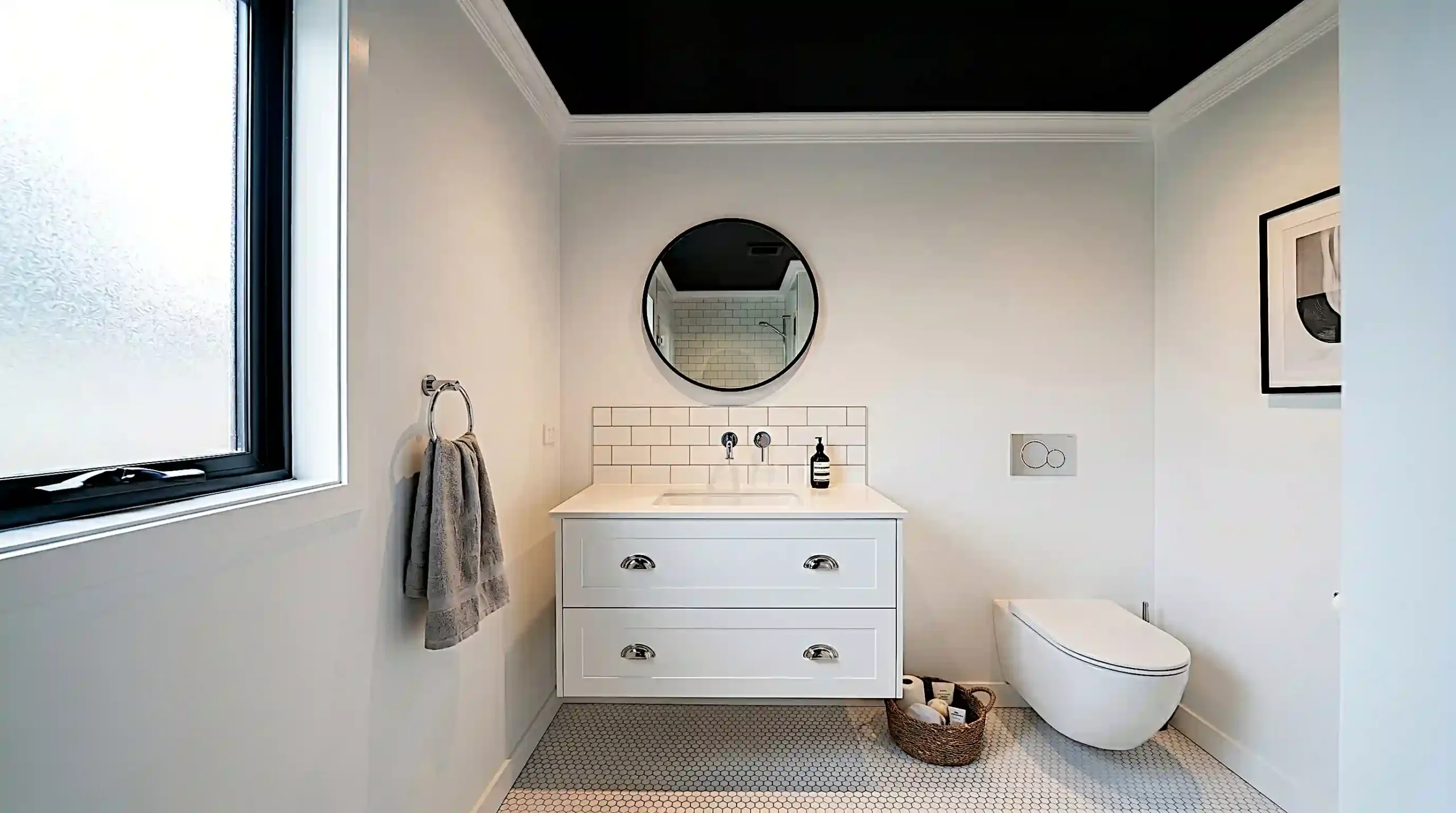
Painting the ceiling dark while keeping the walls white is a design inversion that most homeowners have never considered. Because of this unfamiliarity, it works well as a talking point. The dark ceiling draws the eye upward and creates a sense of drama overhead. As a result, it makes the room feel more intentional and considered.
The Practical Case for This Approach
More practically, a dark ceiling with white walls keeps all the brightness of the white surfaces. At the same time, it adds the moody, moody feel that a fully dark bathroom provides. It is genuinely the best of both approaches for homeowners who want the dark aesthetic without committing fully to dark walls.
Benjamin Moore Black Panther 2125-10 in a flat ceiling finish works well for this use. Flat paint on ceilings is standard practice. Moreover, in bathrooms with adequate ventilation, flat ceiling paint holds up without peeling in high-moisture environments.
Leave the Ceiling Bare
Leave the ceiling completely bare of light fixtures if possible. A dark ceiling with recessed lighting loses much of its dramatic quality because fixtures break the solid dark surface. Therefore, wall-mounted sconces on either side of the mirror provide all the task lighting a bathroom needs. They also leave the dark ceiling as an uninterrupted visual statement overhead.
9. Matte Black and Warm Lighting
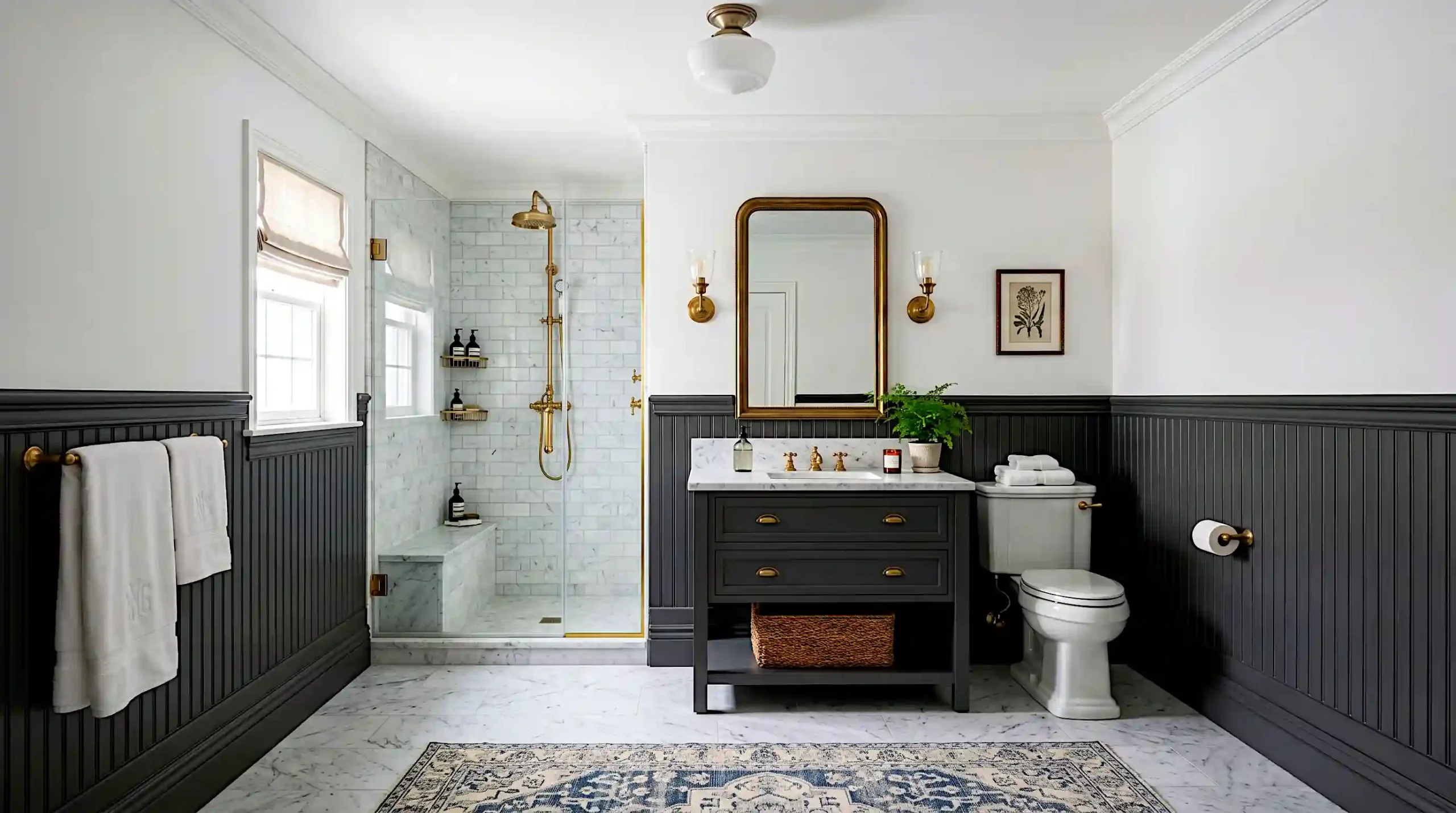
All matte black bathrooms succeed or fail based almost entirely on lighting quality. This is where most attempts at the look go wrong. Matte black surfaces absorb light rather than reflecting it. Therefore, a matte black bathroom with cool white lighting reads as oppressive and unwelcoming. The same bathroom with warm amber lighting reads as a spa. The difference between these two outcomes is the color temperature of the bulbs.
The Right Color Temperature
The target color temperature for a matte black bathroom is 2700 Kelvin or below. This range produces warm, amber-toned light that bounces off dark surfaces as a glow rather than a harsh reflection. Philips Hue’s white ambiance bulbs allow you to dial in the exact color temperature. They also adjust based on time of day. That feature makes them well suited to dark bathrooms where getting the lighting right is essential.
Sconce Placement and Shade Selection
Wall sconces installed at eye level on either side of the mirror provide the most flattering and functional light in any bathroom. In a matte black bathroom specifically, choose sconces with amber or frosted glass shades rather than clear glass. Clear glass allows the bare bulb to create harsh point-source light. As a result, this emphasizes the darkness of the surfaces rather than warming them.
A floating walnut vanity with an LED strip light along its lower edge adds a secondary light source. Additionally, this strip illuminates the floor and creates a visual lift that prevents the dark cabinet from feeling heavy against dark walls.
10. Dark Wainscoting with White Upper Walls
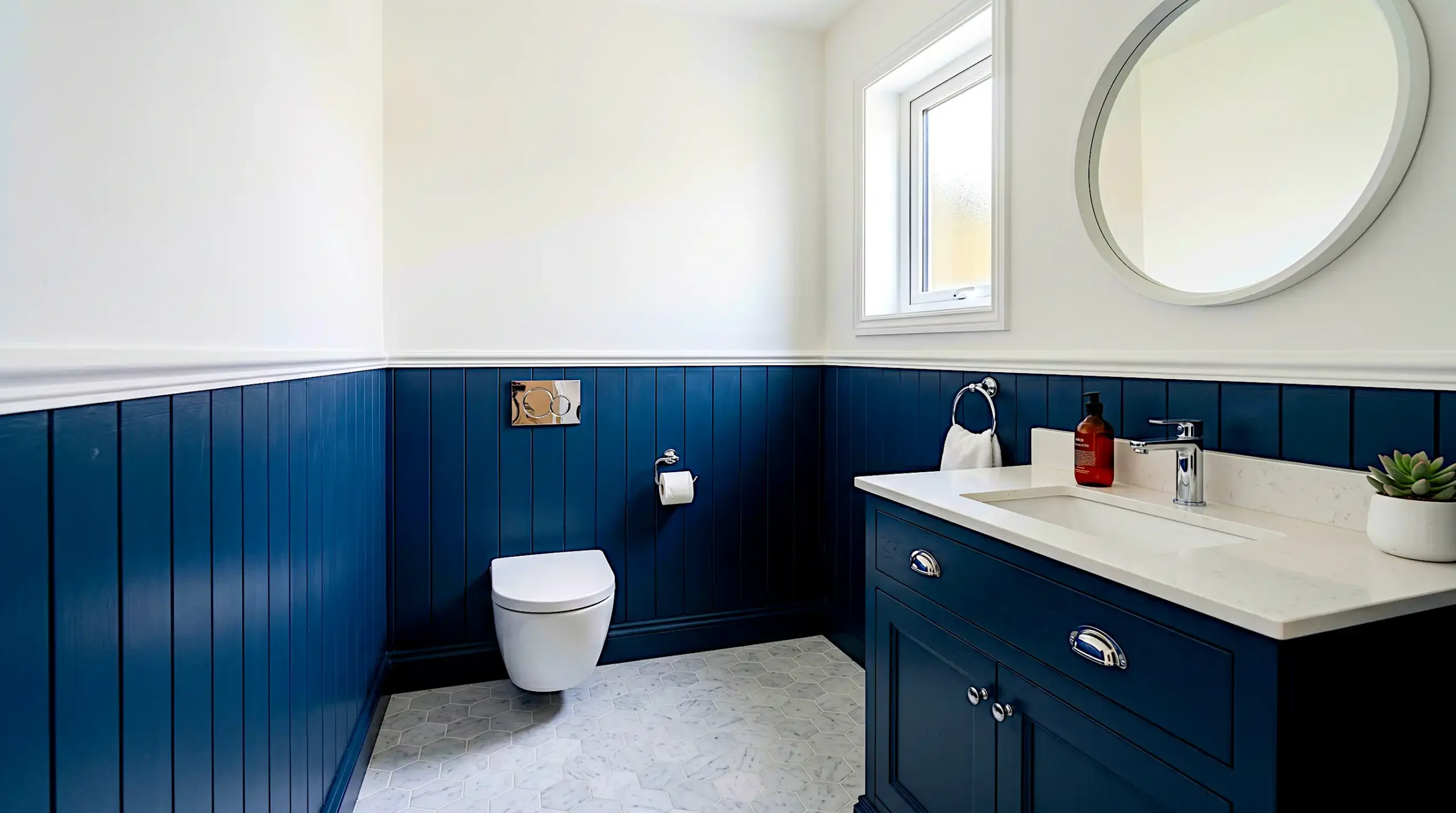
Wainscoting applied in a dark color to the lower half of bathroom walls is one of the most historically grounded dark bathroom approaches. Its longevity as a design choice reflects genuine functional logic. The lower portion of bathroom walls takes the most moisture, splashing, and physical contact. For this reason, a dark, durable paint finish in this zone is both practical and visually intentional.
Getting the Height Right
The dividing line between dark wainscoting and white upper walls should sit at approximately 36 inches from the floor. This corresponds to standard chair rail height and visually balances the two zones in most bathroom ceiling heights. However, going higher than 48 inches with the dark zone starts to make the room feel segmented rather than designed.
Benjamin Moore Hale Navy and Farrow and Ball Railings both perform well as wainscoting colors. Apply them in a satin finish rather than eggshell for the lower wall zone. Specifically, satin provides better moisture resistance in areas most exposed to water and contact.
The Chair Rail Molding Detail
The chair rail molding between the two zones deserves careful attention. A simple, substantial molding in the same white as the upper walls creates a clean clean design line. This makes the two-tone treatment look considered rather than unfinished. Thin, thin moldings undermine the entire scheme. In other words, they make it look like the dark paint simply stopped rather than intentionally ending at a defined point.
11. Slate and Natural Stone Combo
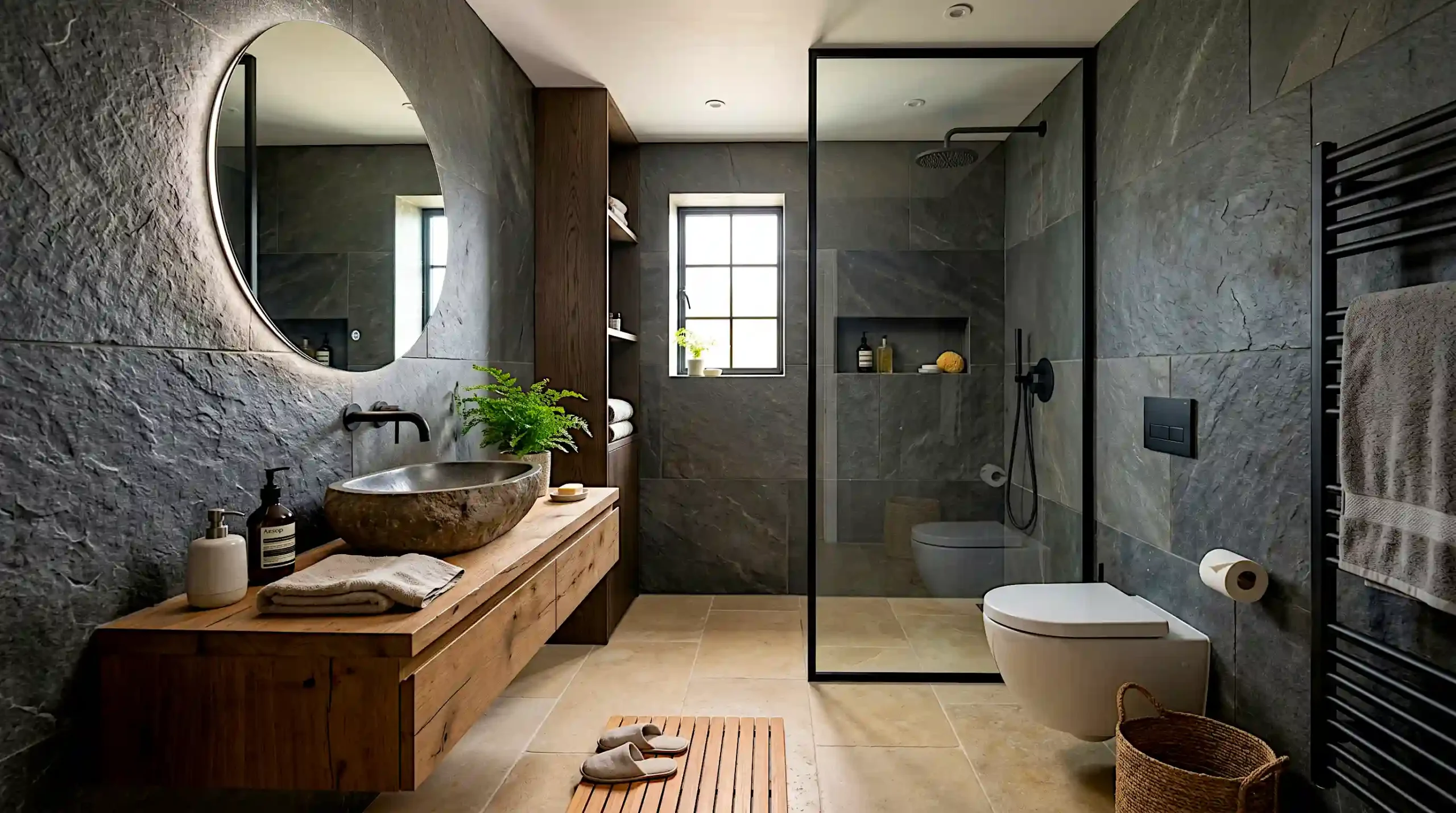
Natural dark stone materials occupy a different category from paint and tile. In fact, they bring genuine texture, variation, and material authenticity that manufactured surfaces cannot replicate. Dark slate in particular offers a surface quality that photographs beautifully, ages gracefully, and feels completely at home in a wet environment.
Why Slate Works in Bathrooms
Slate is naturally water-resistant and slip-resistant in its split-face format. Because of this, it works well in shower floors and walls. It does not need the intensive sealing that polished dark stones like black marble demand. Daltile’s natural cleft slate in charcoal is available in formats from 12 by 12 inches up to 24 by 24 inches. Additionally, it installs with standard large-format tile adhesive.
Pairing Slate with Lighter Materials
Pairing slate walls or shower surrounds with a contrasting lighter floor material prevents the room from feeling enclosed. Dark slate shower walls with large format concrete-look porcelain floor tiles in mid-grey create a layered look. Together, the two materials feel intentional rather than accidental. Moreover, the two materials share a similar tonal family while providing enough contrast to define the different zones of the room clearly.
Sealing Requirements
In practice, the most common mistake with natural stone in bathrooms is insufficient sealing. Apply a deep-stone sealer sealer to dark slate before grouting and again on an annual basis. This prevents the stone from absorbing soap residue and moisture that causes surface staining over time. Consequently, skipping this step is the single most common reason dark stone bathrooms look aged and unkempt within a few years of installation.
12. Dark Wood Vanity with Light Floor
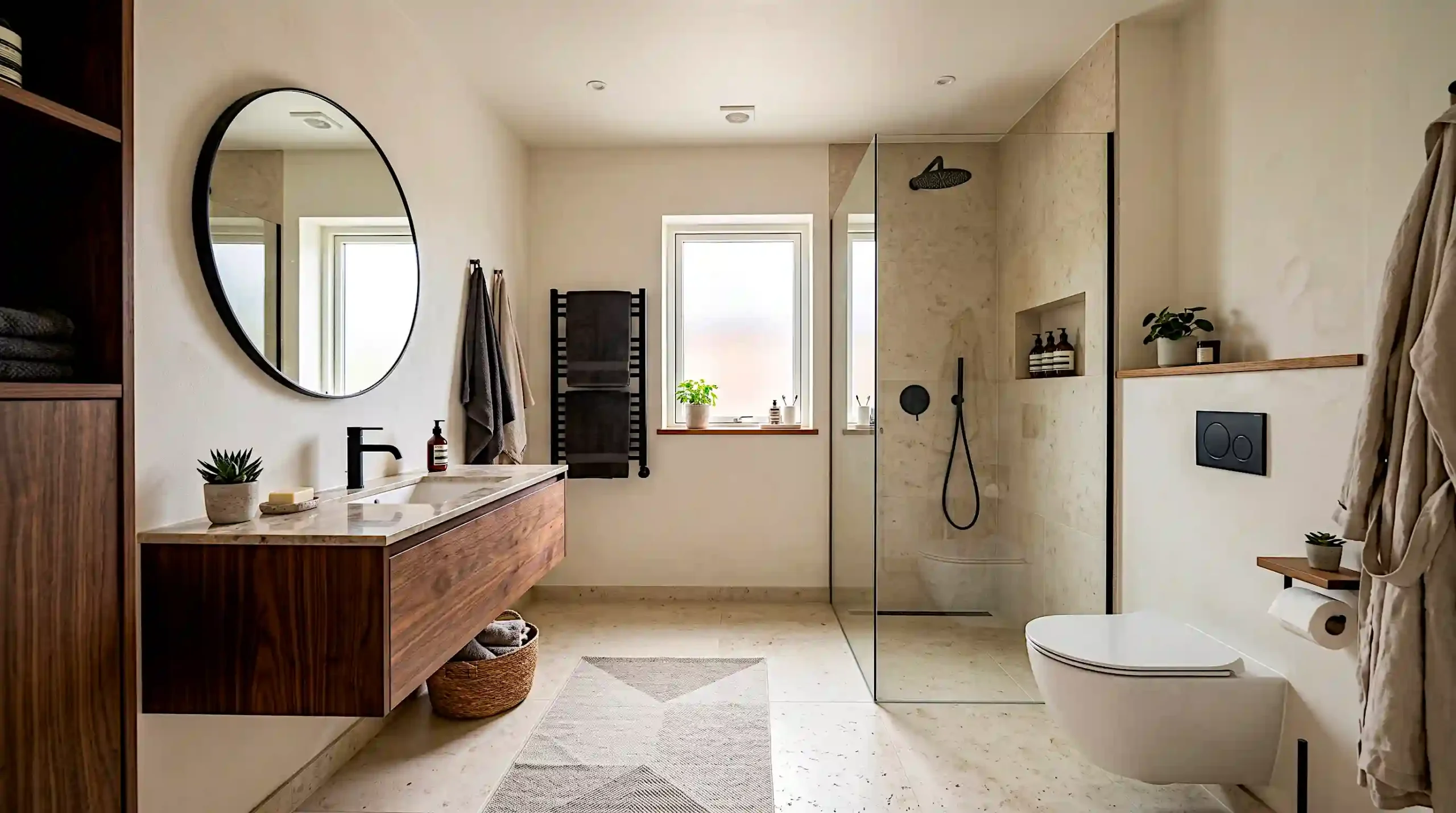
The dark wood vanity against a light floor delivers the moody quality you want. It does this through a single piece of furniture, not through wall treatment. This makes it ideal for renters or homeowners who cannot repaint or retile the fixed surfaces of the room.
Floating vs. Floor-Standing
A deep espresso or ebonized oak floating vanity creates a visual anchor in any bathroom. Place it against white walls with a marble or stone floor and it reads as both luxurious and grounded. The floating installation is critical. For example, a floor-standing dark vanity in a light bathroom can feel heavy and clunky. In contrast, a floating cabinet at 16 to 18 inches off the floor creates breathing room. That gap prevents the dark wood from dominating the space.
Product Recommendations
IKEA’s Hemnes bathroom vanity in black-brown finish at 24 or 32 inches wide provides an accessible entry point into this approach. For a higher-end result, custom walnut floating vanities from companies like Native Trails deliver the material quality you need. In short, they make the dark wood and light floor contrast fully convincing. For more information on paint and finish options that complement dark vanities, Sherwin-Williams offers a free online color consultation tool at sherwin-williams.com.
Brushed or unlacquered brass hardware on a dark wood vanity completes the palette. Against a light floor, it feels warm, current, and classically grounded at the same time. Avoid chrome in this combination. Simply put, it reads as too cold against the natural warmth of wood grain.
13. Moody Dark Bathroom Ideas on a Budget
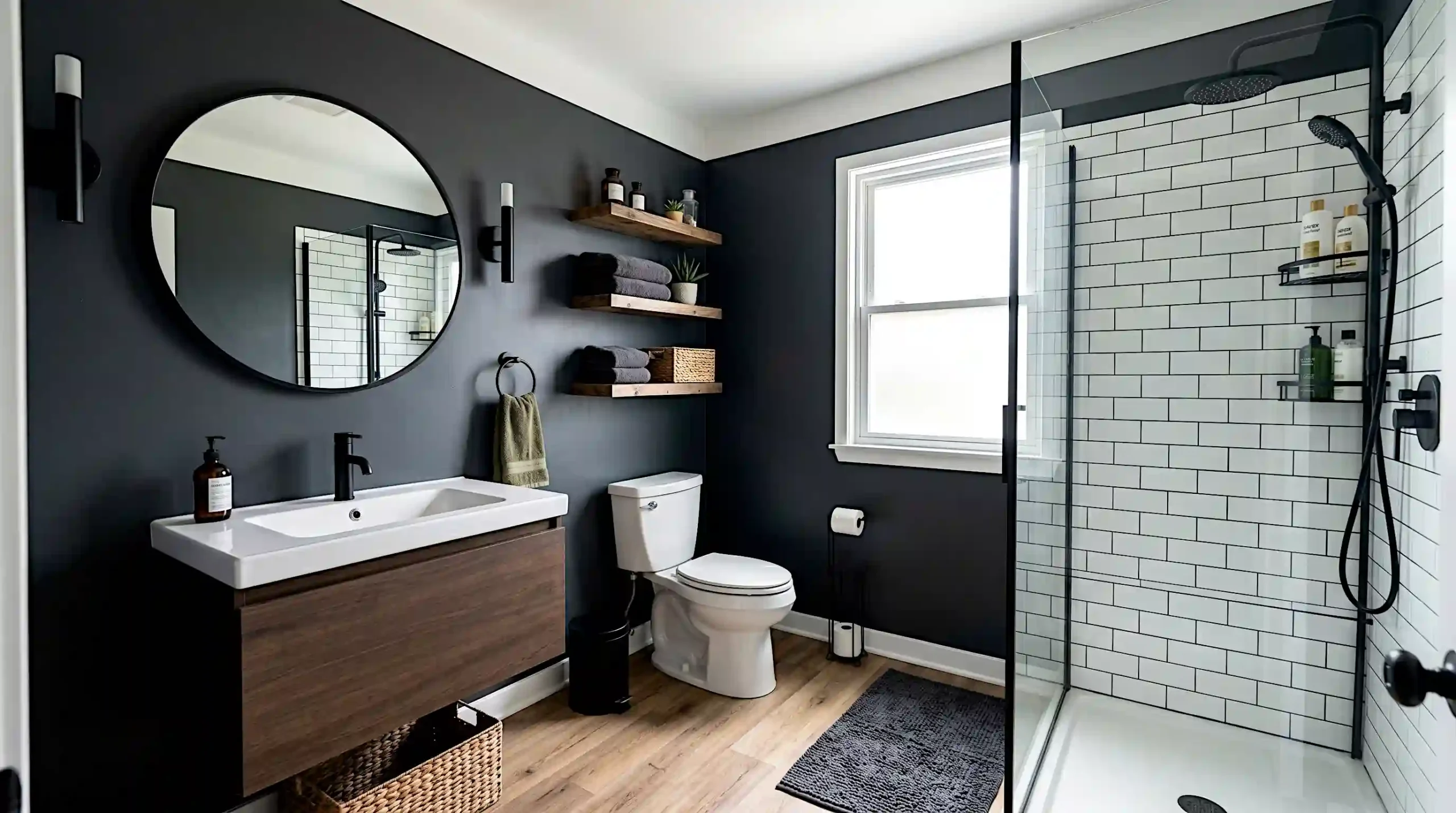
Achieving a dark, moody bathroom without a full renovation budget is genuinely possible. The results always surprise people who assume that good design requires significant spending. The key is understanding which elements have the most visual impact. Prioritize those over changes that look expensive in isolation but contribute little to the overall atmosphere.
Start with Paint
Paint is always the first move and the highest-return investment in any room. In fact, a single gallon of quality paint from Benjamin Moore or Sherwin-Williams costs between 50 and 75 dollars. That one gallon transforms the entire character of a bathroom. Additionally, painting the vanity cabinet rather than replacing it is the second most impactful move. A coat of Rust-Oleum Cabinet Transformations in a dark tone transforms an existing white or oak cabinet completely. The result reads as a custom piece at a fraction of replacement cost.
Swap Fixtures and Mirror
Swapping out a chrome faucet for a matte black equivalent costs between 40 and 150 dollars depending on the brand. Surprisingly, this single change delivers an immediate, visible shift in the bathroom’s personality. Moen’s Align collection in matte black sits at the lower end of this range and offers reliable quality at an accessible price point.
A round black metal framed mirror replaces a builder-grade frameless mirror for under 80 dollars. Dark paint, a repainted vanity, and a matte black faucet work as a set. Together, these three changes create a bathroom that reads as designed rather than default. In other words, it looks intentional from the first glance. The total materials cost typically sits under 300 dollars.
14. Dark Bathroom Ideas for Windowless Spaces
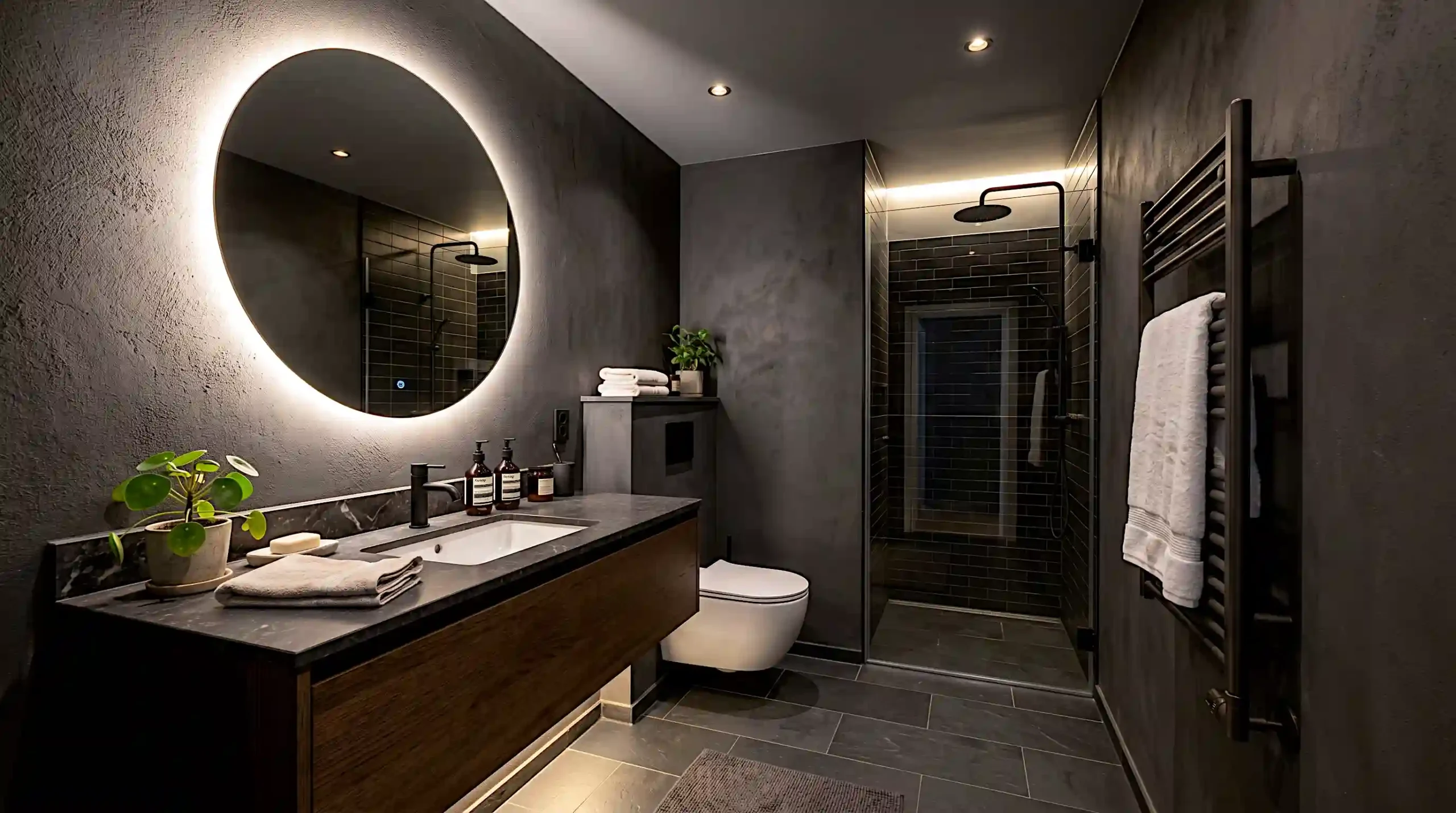
The windowless bathroom is the scenario that makes people most nervous about going dark, and understandably so. Without natural light, a dark-walled room can feel oppressive in a way that a light-walled room avoids. However, the solution is not to avoid dark colors in windowless bathrooms. The solution is layered artificial lighting that does the work natural light would otherwise do.
The Backlit Mirror as Your Starting Point
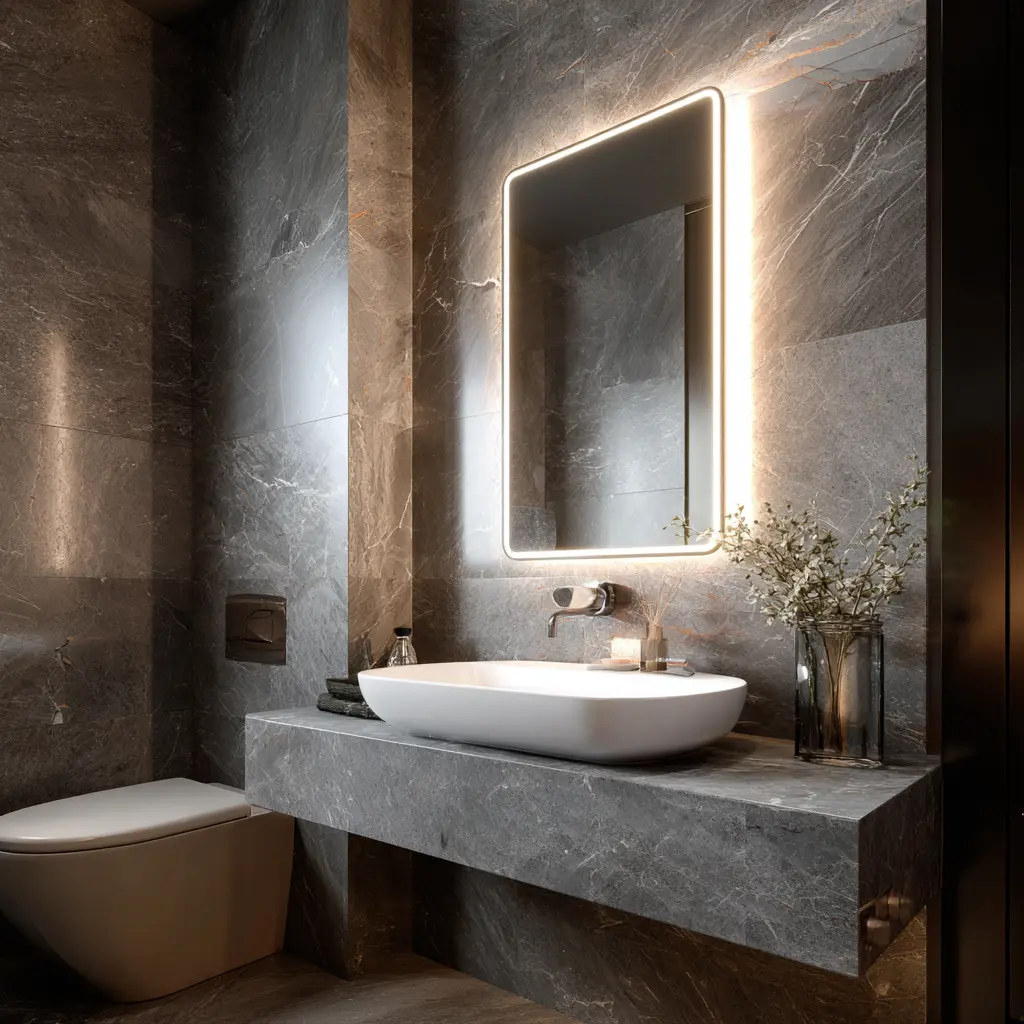
A backlit LED mirror is the single most impactful addition to a windowless dark bathroom. The light emanating from behind the mirror creates an ambient glow that covers the surrounding wall. It also eliminates the harsh shadows that standard overhead lighting produces on dark surfaces. For instance, Robern’s electric lighted medicine cabinets and Kohler’s dedicated LED backlit mirrors both offer this feature at different price points.
Layering Three Light Sources
The layering principle requires at least three independent light sources in a windowless bathroom. First, the backlit or front-lit mirror provides ambient wall glow. Second, wall sconces at eye level deliver task lighting for grooming. Third, an LED strip under the floating vanity adds accent light at floor level. Each source contributes a different quality of light. Moreover, it fills different shadow areas that the other sources miss. Together, therefore, they create the warm, spa-like atmosphere that makes windowless dark bathrooms successful rather than oppressive.
Warm white LED bulbs at 2700 Kelvin in all three sources ensures color consistency across the entire light scheme. Mixing color temperatures between sources in a dark, windowless bathroom is immediately visible. Consequently, it creates an unsettled atmosphere that undermines every other design decision in the room.
15. Dark Bathroom Lighting Rules
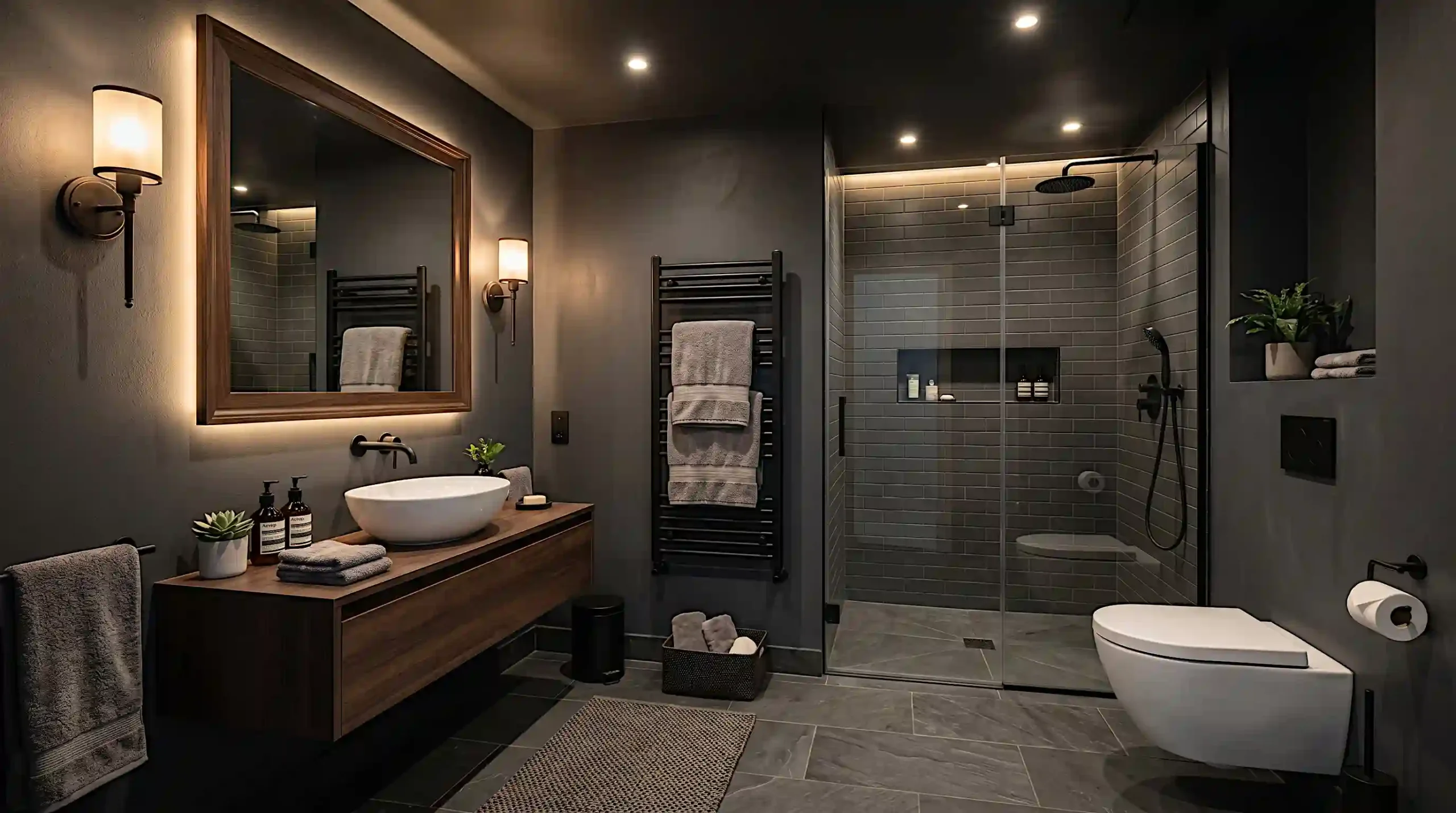
Lighting is not a finishing detail in dark bathroom design. It is a structural element that determines whether the entire scheme succeeds or fails. Every dark bathroom decision made without considering the lighting implications leads to disappointment. The result looks different in photographs than it does in real life. Almost always, it looks worse.
The Three-Layer Rule
The three-layer rule applies to every dark bathroom regardless of size. Task lighting at the mirror handles grooming. Ambient lighting at wall level fills the room. Accent lighting at floor or cabinet level adds depth. Together, they eliminate flat, shadowless light. In a bathroom with dark walls, flat overhead lighting is the worst possible choice. It casts downward shadows that emphasize the depth of the color without adding any warmth or dimension. As a result, the space feels flat and oppressive rather than moody and considered.
Color Rendering Index
Color rendering index, known as CRI, matters more in dark bathrooms than in light ones. A CRI of 90 or above ensures that dark surfaces show their true color. Otherwise, they appear as a murky, indistinct mass. Cree Lighting’s LED bulbs consistently achieve CRI ratings of 90 and above across their residential range. Moreover, they are widely available at major hardware retailers including Home Depot and Lowe’s.
For comprehensive guidance on lighting standards for residential bathrooms, the Illuminating Engineering Society publishes recommended lux levels for task and ambient bathroom lighting at ies.org.
Mirror Lighting Lux Levels
Mirror lighting should provide approximately 75 to 100 lux at face level to function properly as task lighting. This gives enough light to apply makeup or shave comfortably. The mirror area stays bright enough for grooming without conflicting with the moody atmosphere of the rest of the room. A dimmable circuit on all bathroom lighting solves both needs at once. The same space functions as a bright morning bathroom and a low-light evening retreat without any compromise.
A Dark Bathroom Done Well Is Worth Every Decision
A dark bathroom executed with care is one of the most satisfying rooms in a home to walk into. The sense of calm and luxury that a well-chosen dark palette delivers is genuinely difficult to replicate with light colors. No matter how carefully you select them, light colors simply do not produce that feeling.
The 15 approaches covered here range from a single painted accent wall to full natural stone installations. There is a realistic entry point at every budget and commitment level. Start with the change that fits your current situation and build from there as your confidence grows.
When you are ready for the next step, explore our guide on [small bathroom ideas]. You will see how dark palettes work across different room sizes and layouts.
Frequently Asked Questions
Dark bathrooms work extremely well when the lighting is properly planned. The common concern that dark colors make bathrooms feel smaller is largely a myth. With adequate layered lighting, a dark bathroom feels intimate and luxurious rather than cramped. The key is choosing the right finish and ensuring at least two to three independent light sources across the space.
Charcoal gray and deep navy always perform best in small bathrooms because they read as neutrals rather than saturated colors. Both reflect enough light to prevent the room from feeling enclosed. At the same time, they deliver the moody feel that dark bathrooms are known for. Pair either color with warm white on remaining walls for the best balance.
Install a large frameless mirror on one full wall. Additionally, use warm layered lighting from at least three sources. Keep the floor tile light or reflective, and paint only one accent wall rather than all four. These four changes together can make a small dark bathroom feel significantly larger than its actual dimensions suggest to anyone who walks in.
Yes, but the lighting plan becomes even more critical than usual. A backlit LED mirror provides the first light layer. Wall-mounted sconces at eye level add the second. An LED strip under the vanity completes the third. Together, they give a windowless dark bathroom everything it needs. Keep all bulbs at 2700 Kelvin for warmth and consistency, and consider a dimmable switch to control atmosphere across the day.
Dark green bathrooms in forest and hunter green tones are the dominant trend in 2026. They always outperform navy and charcoal in search volume and social media engagement across platforms. The forest green and warm wood vanity combination has emerged as the signature dark bathroom pairing of 2026. It has replaced the all-navy look that dominated 2023 and 2024.
Recent Posts
15 Dark Bathroom Ideas Designers Actually Use
Small Kitchen Remodel Ideas: 15 Expert Design Strategies for 2026

Best Bathroom Flooring Ideas: Complete Expert Guide for 2026