25 Japandi Bedroom Ideas by Room Size: AI Designs You Can Actually Copy (2026)
Written by: M. Yazdaan, Home Decor Editor
Reviewed by: Emma Cartel, Research and Editorial Standards Coordinator
Most Japandi bedroom guides show you beautiful rooms without telling you one critical thing. Room size completely changes which ideas actually work.
A floor-level futon and empty walls look intentional in a 120 square foot studio. In a 300 square foot master bedroom, the same setup looks unfinished and cold. That single detail is why so many people try Japandi, feel disappointed with the result, and blame the style instead of the approach.
This guide solves that problem. All 25 designs are organized by room size so you can find ideas built for your specific space and copy them with confidence.
Every design you see here was generated using AI based on authentic Japandi principles: natural materials, intentional negative space, warm neutral palettes, and the balance between Japanese wabi-sabi and Scandinavian hygge.
QUICK ANSWER BOX
What is Japandi bedroom style?
Japandi combines Japanese minimalism with Scandinavian warmth. It uses natural wood, neutral tones, minimal decor, and intentional negative space to create bedrooms that feel calm, grounded, and purposefully beautiful.
Best Japandi ideas for small rooms: Designs 1 to 8
Best Japandi ideas for medium rooms: Designs 9 to 18
Best Japandi ideas for large rooms: Designs 19 to 25
What Makes Japandi Different From Regular Minimalism
Before you choose a design, it helps to understand what separates Japandi from plain minimalism. The difference is warmth.
Standard minimalism removes things. Japandi removes the right things and replaces them with carefully chosen natural elements that make the room feel alive rather than empty. Think of the difference between a bare white room and a room with one beautiful olive tree, warm oak floors, and linen bedding that looks like it has been washed a hundred times in the best possible way.
The Three Rules Every Japandi Bedroom Follows
Every design in this guide follows these three principles. They apply regardless of room size.
Natural materials only. Wood, linen, cotton, jute, rattan, bamboo, ceramic, and stone. Plastic, chrome, and synthetic fabrics break the aesthetic immediately.
Warm neutrals, not cool ones. Japandi uses cream, oat, warm white, clay, sand, and soft sage. It avoids bright white, cool gray, and stark black except as very subtle accents.
Negative space is furniture. The empty wall, the clear floor beside the bed, and the bare corner are not mistakes. They are part of the design.
Keep these three rules in mind as you browse the 25 designs below.
Small Bedroom Japandi Ideas: Under 150 Square Feet
Small bedrooms are actually where Japandi shines brightest. The style’s natural restraint works perfectly in compact spaces because every choice becomes intentional by necessity. You simply cannot fill a small room with Japandi pieces even if you tried.
The key principle for small Japandi bedrooms is low furniture and vertical space. Low platform beds visually expand floor space. A single wall shelf does more than a full dresser. One large plant beats three small ones every single time.
Here are eight designs built specifically for rooms under 150 square feet.
Design 1: The Studio Sanctuary
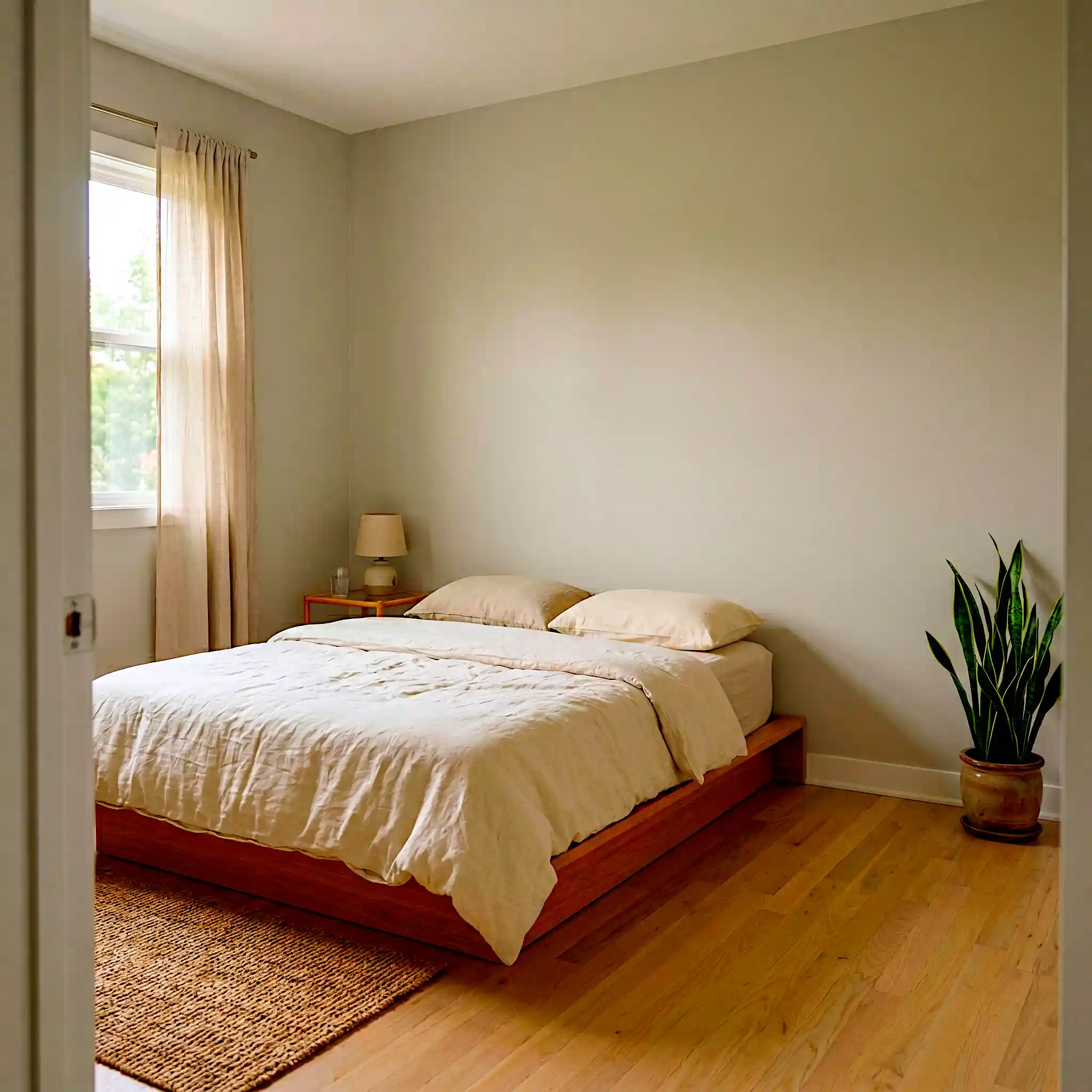
This is the entry point for Japandi in a small space. The low oak platform bed sits centered without a headboard, which opens up the wall visually and makes the ceiling feel higher. Cream linen bedding keeps the palette completely calm.
Notice the single snake plant in the corner. One large plant at floor level creates more visual impact than multiple small ones scattered around the room. The slim bamboo nightstand holds only a ceramic lamp. Nothing else sits on its surface.
What to buy for this look:
- Low platform bed frame in natural oak
- Cream linen duvet cover
- Slim bamboo nightstand
- White ceramic table lamp
- Large snake plant in a simple terracotta pot
Design 2: Floating Shelf Minimalism
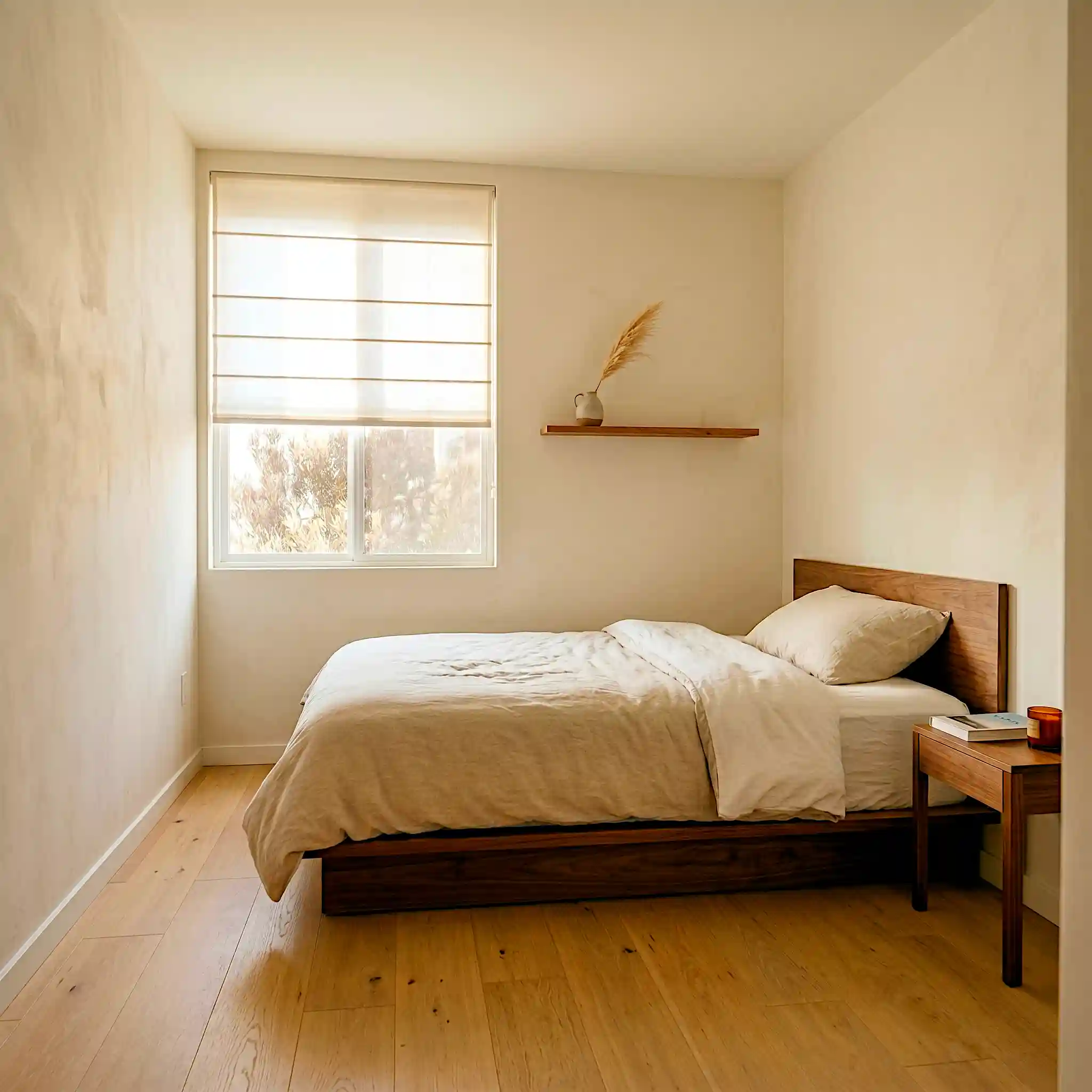
When floor space is tight, move storage upward. This design replaces the traditional nightstand with a single floating wooden shelf positioned at nightstand height. On it sits one small ceramic vase and one dried pampas stem. Nothing else.
The shoji-inspired roller blind diffuses morning light beautifully without taking up any space. The floor stays completely clear except for the bed and one slim wooden nightstand on the right side only. Asymmetry in small Japandi rooms feels intentional, not incomplete.
What to buy for this look:
- Floating oak wall shelf, 32 inch width
- Shoji style roller blind in natural linen
- Small dried pampas stem in ceramic vase
- Single wooden nightstand, right side only
Design 3: Dark Wood Contrast
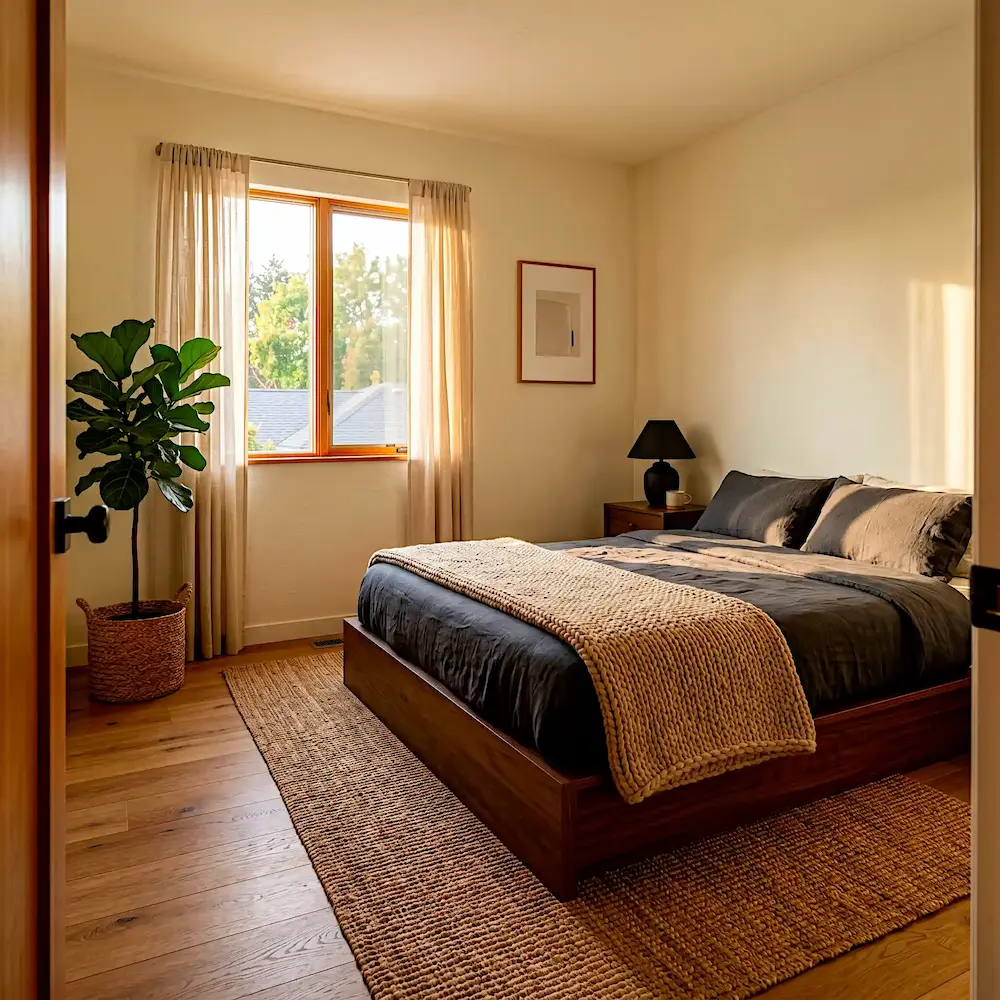
Most people assume small Japandi bedrooms need to stay light. This design proves otherwise. The dark walnut platform bed against warm off-white walls creates a confident contrast that makes the room feel considered rather than cramped.
The charcoal linen bedding deepens the palette without making the room dark. A warm beige knit throw at the foot of the bed softens the drama. The fiddle leaf fig in a woven basket planter brings life and height without taking up meaningful floor space.
This works because the walls stay very warm and light. The dark furniture grounds the room rather than closing it in.
What to buy for this look:
- Dark walnut low platform bed
- Charcoal linen duvet cover
- Warm beige chunky knit throw
- Woven basket planter with fiddle leaf fig
- Jute rug in warm natural tones
Design 4: Earth Tone Renter
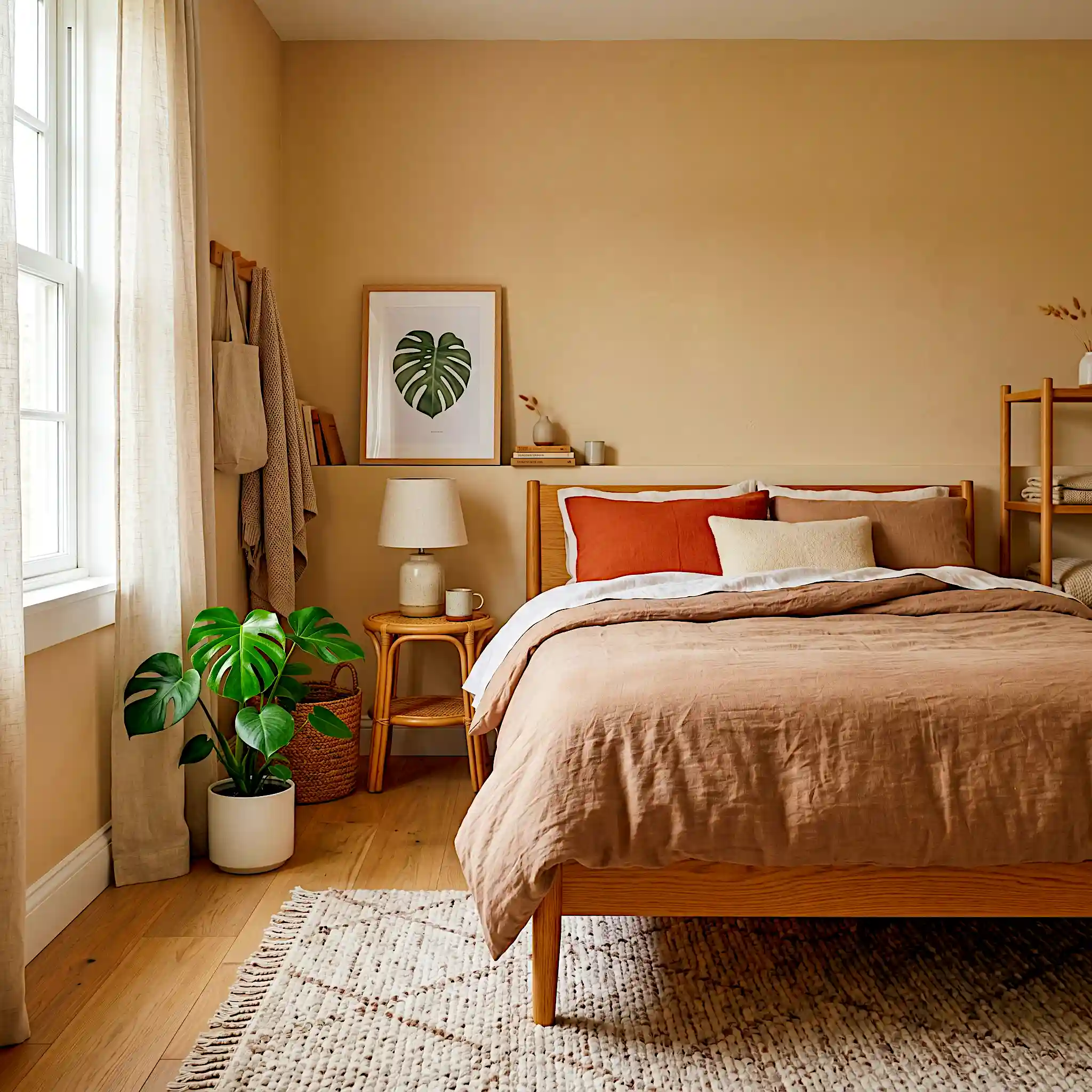
This design is built specifically for renters. Every element is moveable, nothing is permanent, and the total transformation cost stays under $400.
The clay colored linen duvet is the star of this look. It brings warmth and Japandi character to any bed frame you already own. The terracotta accent pillow, rattan nightstand, and monstera plant in a white ceramic pot complete the palette without requiring any wall changes or permanent fixtures.
The framed botanical print leans against the wall rather than hanging on it. That single decision makes this look completely renter-proof.
What to buy for this look:
- Clay linen duvet cover (under $80)
- Terracotta accent cushion
- Small rattan nightstand
- Monstera plant in white ceramic pot (under $35)
- Botanical print in natural wood frame, leaning style
Design 5: Ultra Minimal Studio
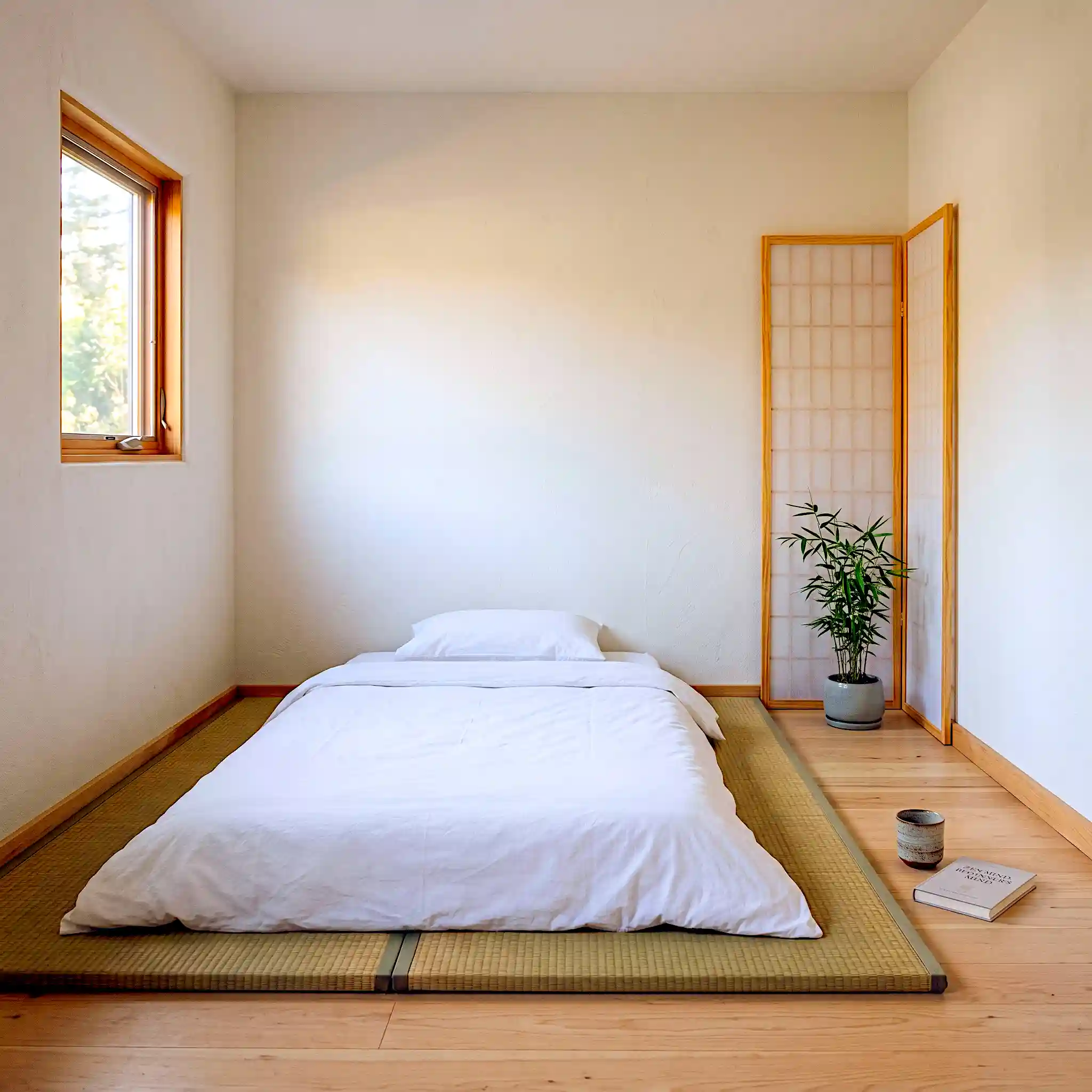
This is the most Japanese-influenced design in the small bedroom section. The floor-level futon on a tatami-inspired woven mat removes the bed frame entirely, which frees up significant visual space in a very compact room.
The shoji screen panel in the corner serves two purposes. It creates a soft visual boundary and adds a distinctly Japanese character to the space. One ceramic cup and one book sit beside the sleeping area on the floor. No nightstand is needed.
This look requires confidence to pull off. But in a room under 120 square feet, the floor-level approach makes the space feel intentional and calm rather than cramped.
What to buy for this look:
- Japanese style floor futon mattress
- Woven tatami mat, 4×6 feet
- Shoji screen room divider panel
- Small potted bamboo plant at floor level
Design 6: Warm Nook Bedroom
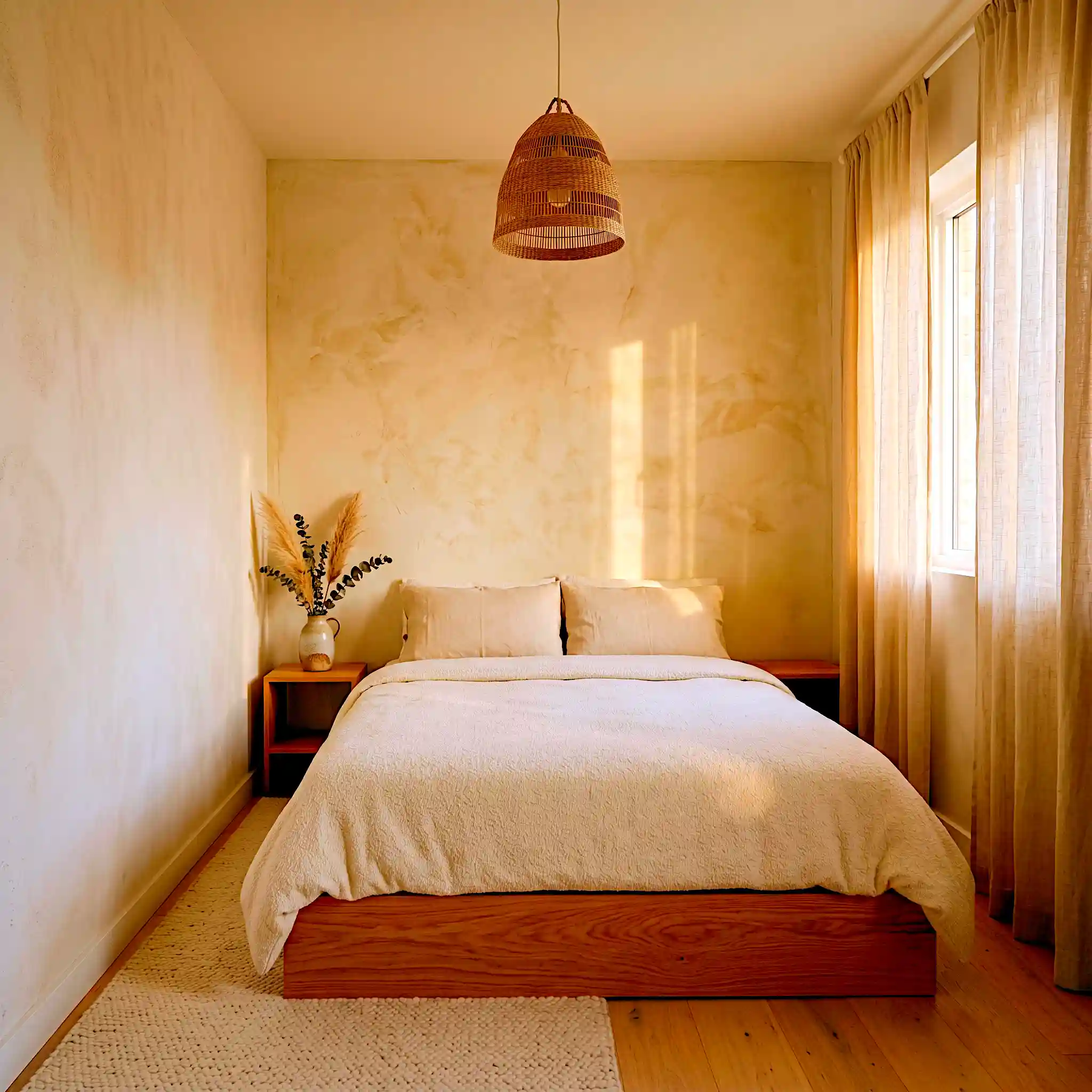
The rattan pendant light above the bed is the detail that makes this design feel warm rather than spare. Overhead lighting in Japandi bedrooms should always be warm and diffused. It should never be bright or clinical.
The boucle duvet cover adds texture without pattern. Boucle is one of the best fabric choices for Japandi because it reads as luxurious while staying completely neutral. The warm plaster effect on the wall behind the bed gives this small room a boutique hotel quality that is surprisingly easy to achieve.
What to buy for this look:
- Rattan woven pendant light
- Cream boucle duvet cover
- Low platform bed in oak
- Plaster effect wall paint in warm clay
- Cream textured wool rug
Design 7: Monochrome Sand
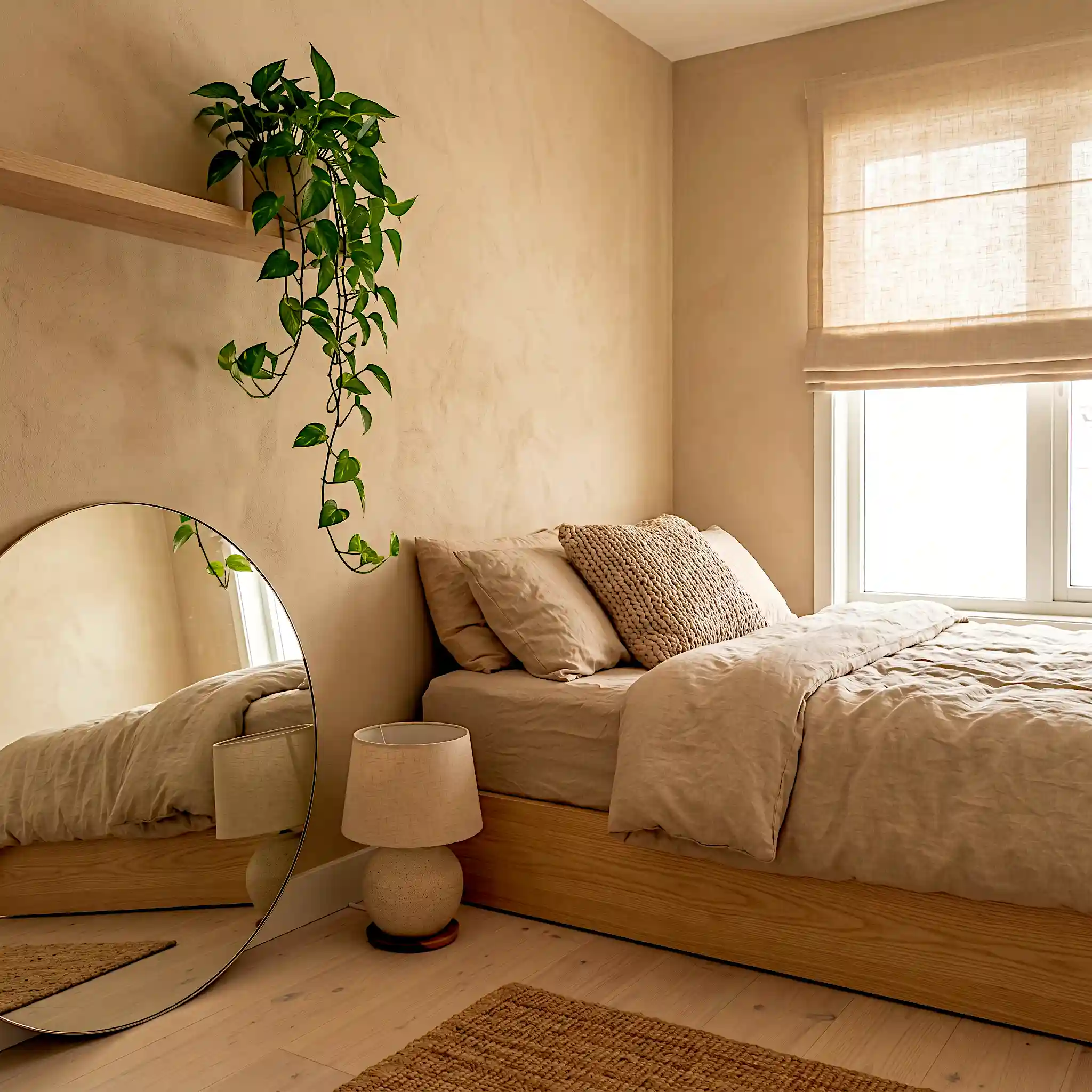
Tonal dressing is one of the most underused Japandi techniques for small bedrooms. When walls, bedding, floor, and accessories all live in the same sand and beige family, the room reads as significantly larger than it actually is.
The round mirror leaning against the wall reflects light from the window and doubles the sense of space. The trailing pothos on a slim floating shelf adds a soft organic element without breaking the monochromatic palette.
What to buy for this look:
- Sand or oat linen duvet
- Round mirror in thin natural wood frame, leaning
- Trailing pothos in a simple ceramic pot
- Warm sand or greige wall paint
- Pale wood floor or floor-toned area rug
Design 8: Small Room Gallery Wall
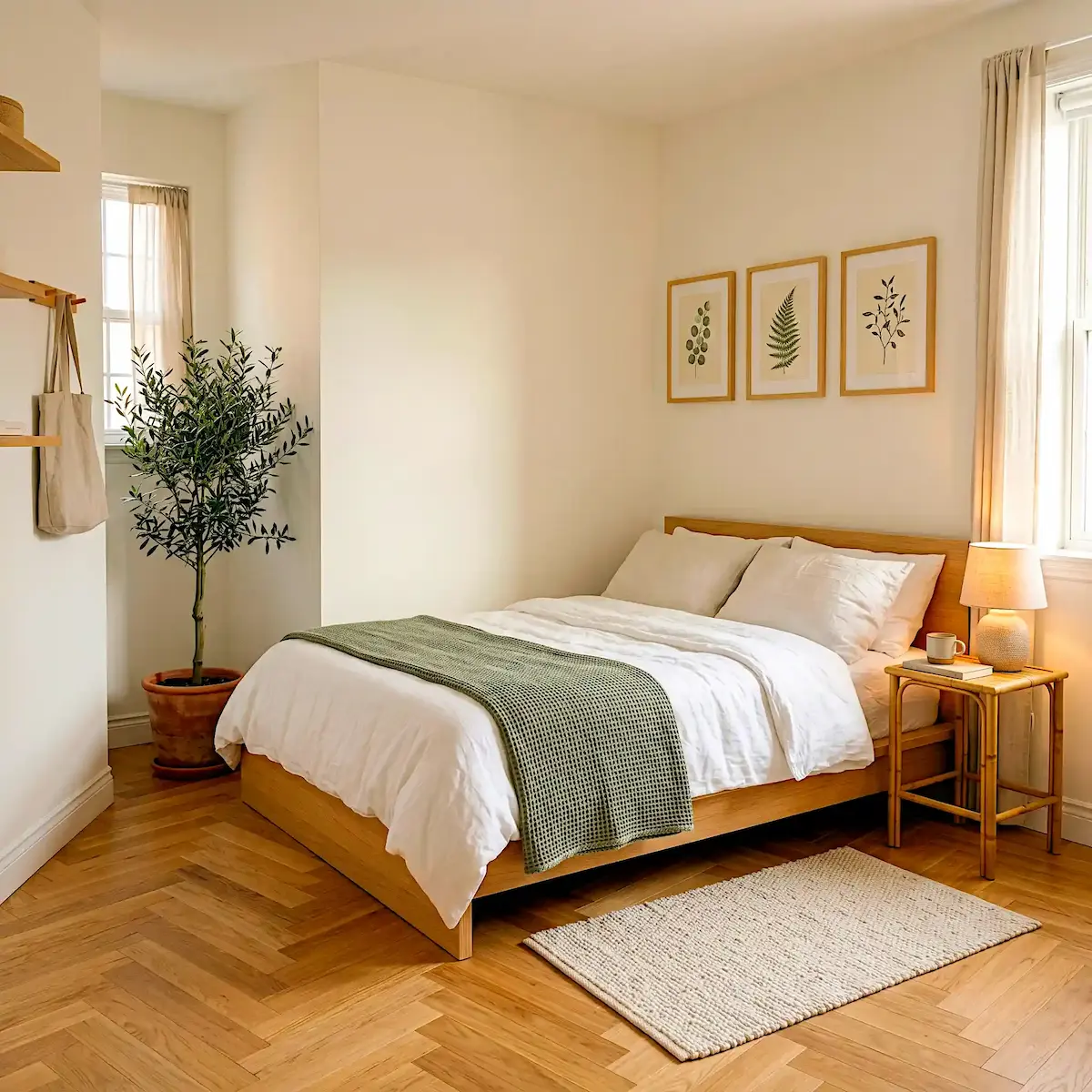
A gallery wall in a small Japandi bedroom works only when you follow one rule. Three prints maximum, all in matching natural wood frames, and all with botanical subject matter.
This design uses three small botanical prints evenly spaced above the bed. The sage green throw on the white linen bedding introduces a quiet color note that ties the greenery of the olive tree in the corner to the bedding palette.
Everything else stays restrained. One slim bamboo nightstand. One ceramic lamp. The gallery wall gets to breathe because the rest of the room steps back.
What to buy for this look:
- Three botanical prints in natural oak frames
- Sage green linen throw
- Olive tree in terracotta pot
- Slim bamboo nightstand
Medium Bedroom Japandi Ideas: 150 to 250 Square Feet
Medium bedrooms give you real room to breathe. You can add symmetry, introduce a reading chair, use a larger rug, and bring in taller plants without the space feeling crowded.
The key principle for medium Japandi bedrooms is balance with purpose. Every addition should earn its place. A reading chair only belongs if someone actually reads. A second nightstand only works if the symmetry feels natural to the room layout.
Here are ten designs built for rooms between 150 and 250 square feet.
Design 9: The Classic Japandi
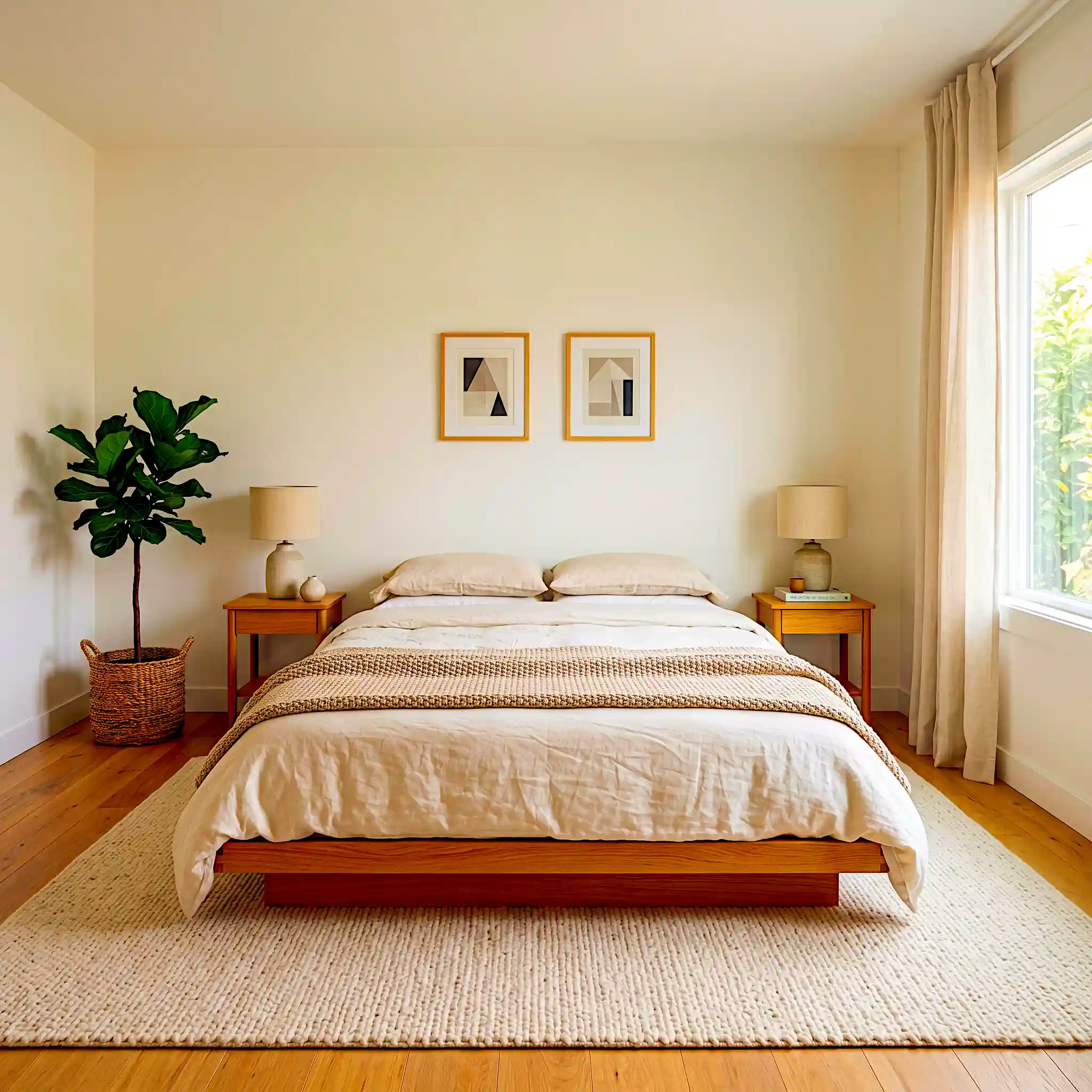
This is the reference design. If you showed someone a Japandi bedroom and asked them to explain the style, this room would be their example.
Two matching slim oak nightstands sit on either side of the bed. One ceramic lamp on each side. Cream and warm white linen bedding with a single chunky knit throw at the foot. A large cream textured wool rug extends well beyond the bed edges. One fiddle leaf fig anchors the corner in a woven basket. Two small framed abstract prints hang above the bed in thin natural frames.
Every element is balanced. Every element earns its place. Nothing competes for attention.
What to buy for this look:
- Matching pair of slim oak nightstands
- Matching pair of ceramic linen-shade lamps
- Cream linen duvet with chunky knit throw
- Large cream wool area rug, at least 8×10 feet
- Fiddle leaf fig in woven basket planter
Design 10: Wabi-Sabi Warmth
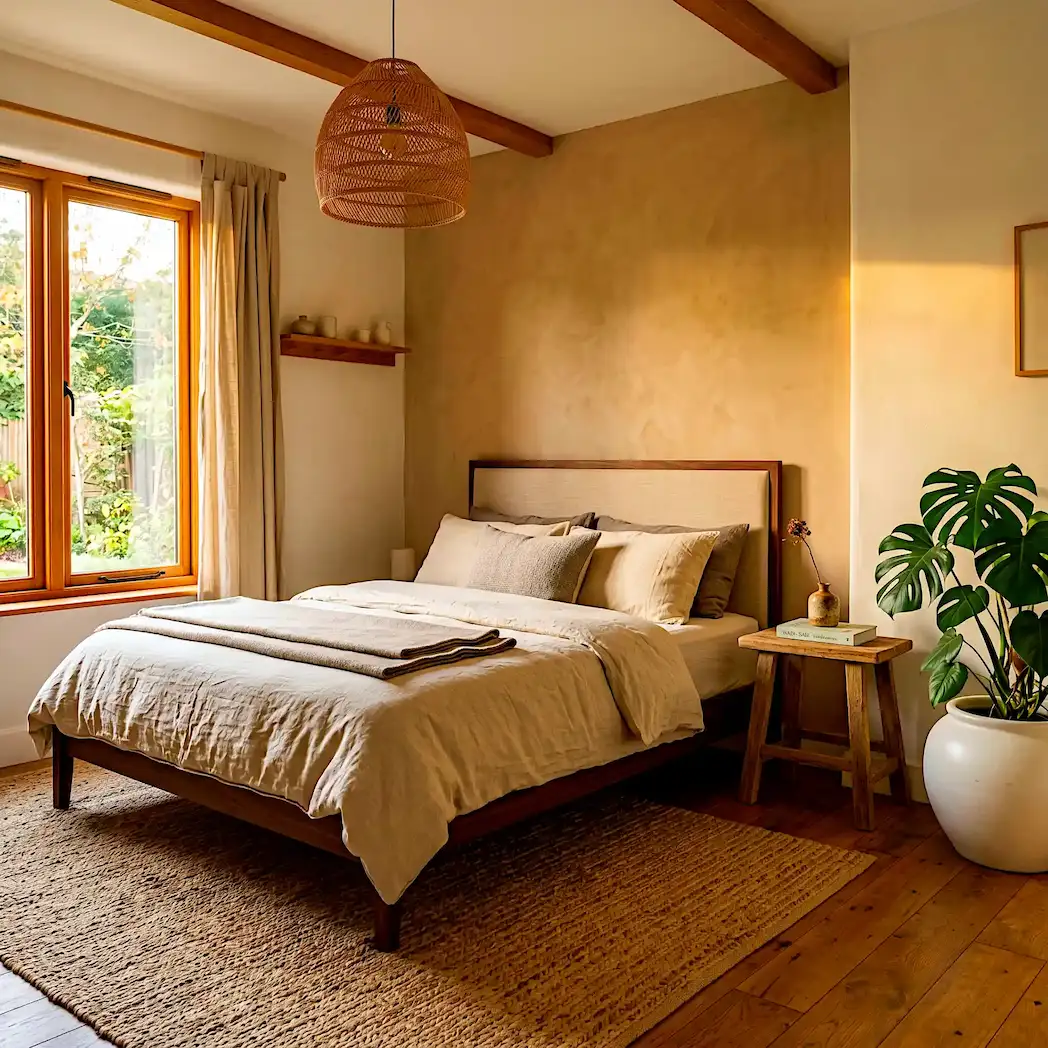
Wabi-sabi is the Japanese philosophy of finding beauty in imperfection. This design applies that principle through texture. The weathered oak nightstand, the handwoven jute rug with visible irregularities, and the clay-toned plaster wall behind the bed all carry that sense of natural authenticity.
The oatmeal duvet with layered cream and warm gray pillows feels genuinely lived-in. The single dried stem in a ceramic bud vase on the nightstand is the kind of detail that signals real design intelligence. It costs almost nothing and says everything about the room’s philosophy.
What to buy for this look:
- Linen headboard panel in oatmeal
- Clay limewash paint for feature wall
- Handwoven jute rug
- Ceramic bud vase with single dried stem
- Rattan pendant light
Design 11: Shoji Screen Privacy
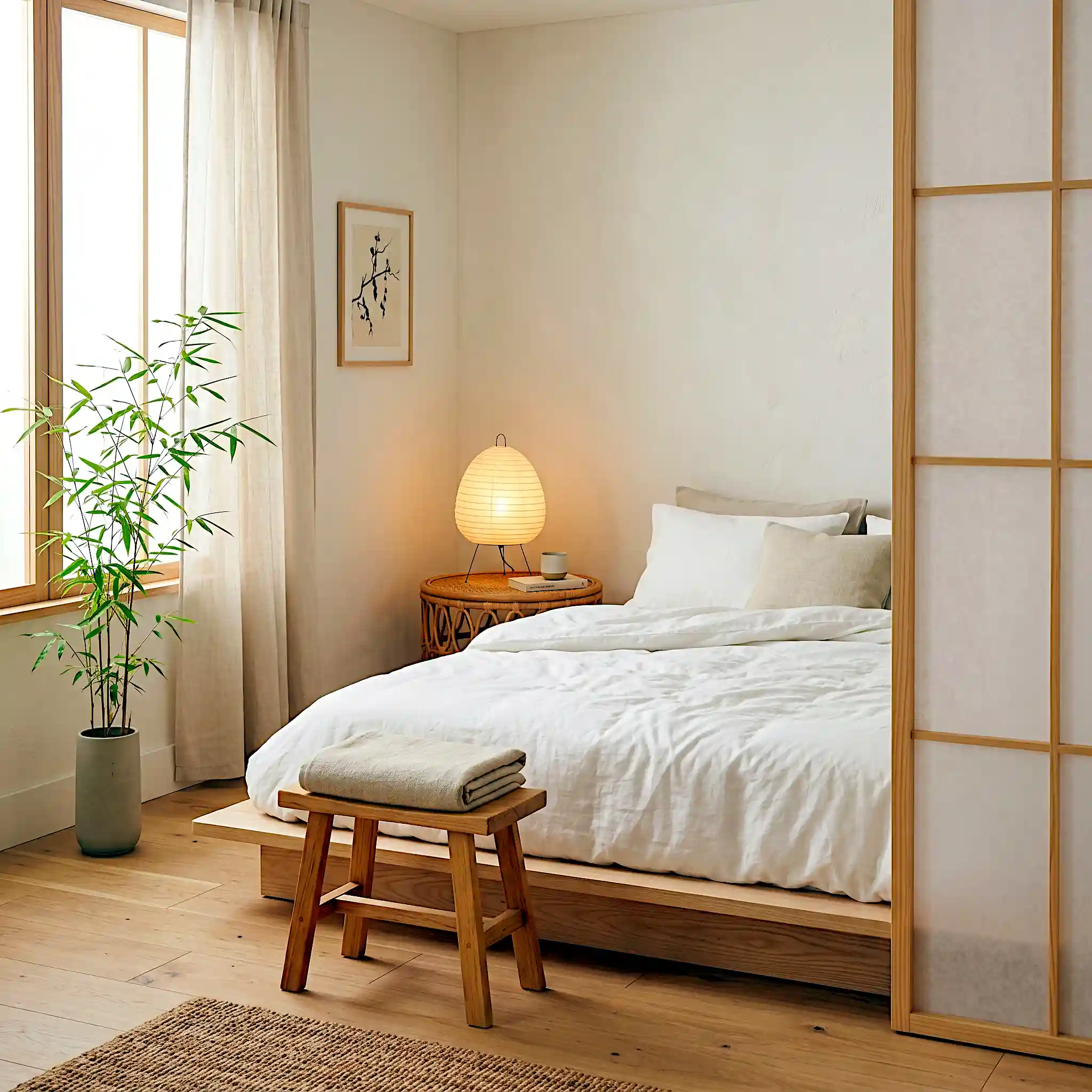
The shoji screen panel beside the bed is both functional and beautiful. It creates a soft visual division in a medium bedroom without building any permanent structure. In a studio apartment or open-plan bedroom, it defines the sleeping zone clearly and intentionally.
The paper lantern lamp beside the bed casts the warmest and most diffused light possible. Japandi lighting should never be harsh. This room demonstrates exactly what warm ambient light does for a bedroom atmosphere in the evening hours.
What to buy for this look:
- Shoji screen room divider panel, two to three sections
- Paper lantern floor lamp
- Low platform bed in pale ash wood
- White cotton duvet with minimal pillow count
- Slim bamboo plant in ceramic pot
Design 12: Textured Accent Wall
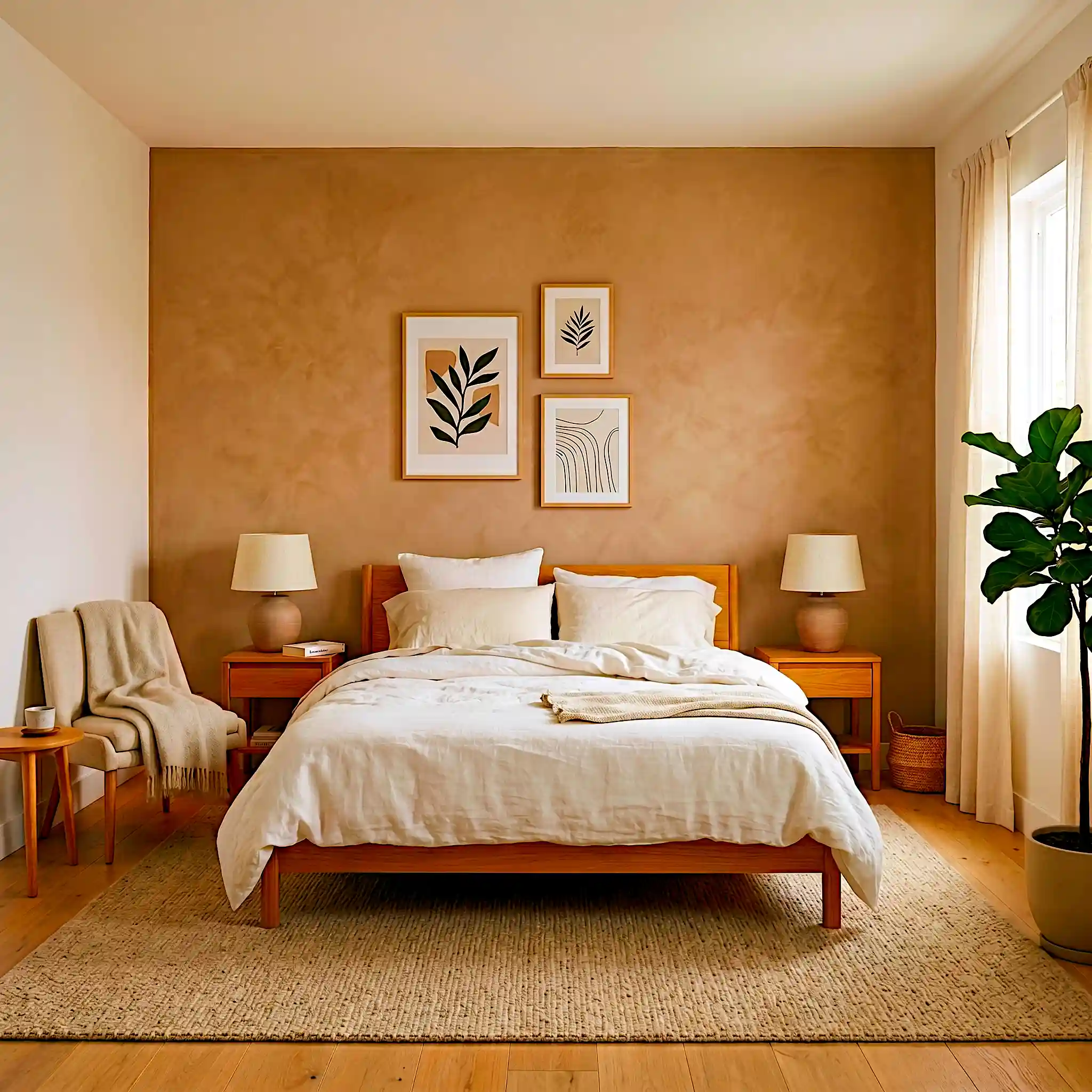
The limewash clay wall behind the bed transforms this medium bedroom from pleasant to memorable. Limewash paint is one of the most effective and affordable ways to bring Japandi character to a room. Use it on one wall only, always behind the bed, and always in a warm clay or sand tone.
The reading chair in natural linen fabric with slim wooden legs in the corner adds functionality without visual weight. It sits far enough from the bed to feel like a separate moment in the room rather than an afterthought.
What to buy for this look:
- Limewash wall paint in warm clay tone
- Linen upholstered reading chair with oak legs
- Large low-pile sand area rug
- Two matching slim nightstands in oak
- Single ceramic lamp, left side only
Design 13: Sage and Oak
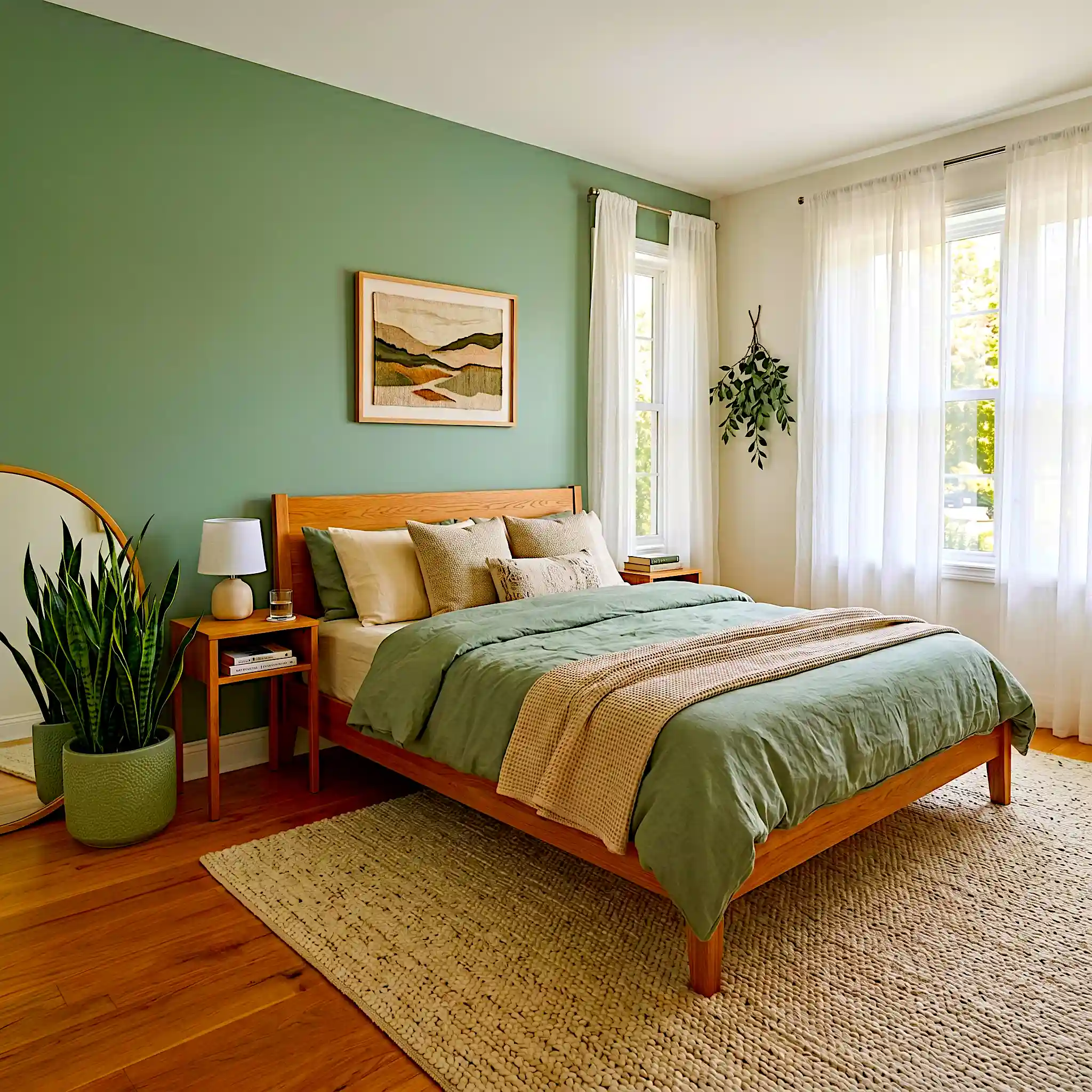
Sage green is the one color that Japandi absorbs beautifully. It reads as natural and botanical rather than decorative. This design uses sage on every wall, not just one accent wall, which creates a completely immersive nature-inspired atmosphere throughout the room.
The medium oak furniture and cream linen bedding balance the sage walls perfectly. A round mirror in a thin natural wood frame leans against one wall and reflects the plant in the corner, effectively doubling its presence in the room without taking up any additional floor space.
What to buy for this look:
- Sage green matte wall paint
- Medium oak platform bed frame
- Cream linen duvet with oat accent pillows
- Round wood-framed mirror, leaning style
- Large snake plant in sage ceramic pot
Design 14: Platform Bed Luxury
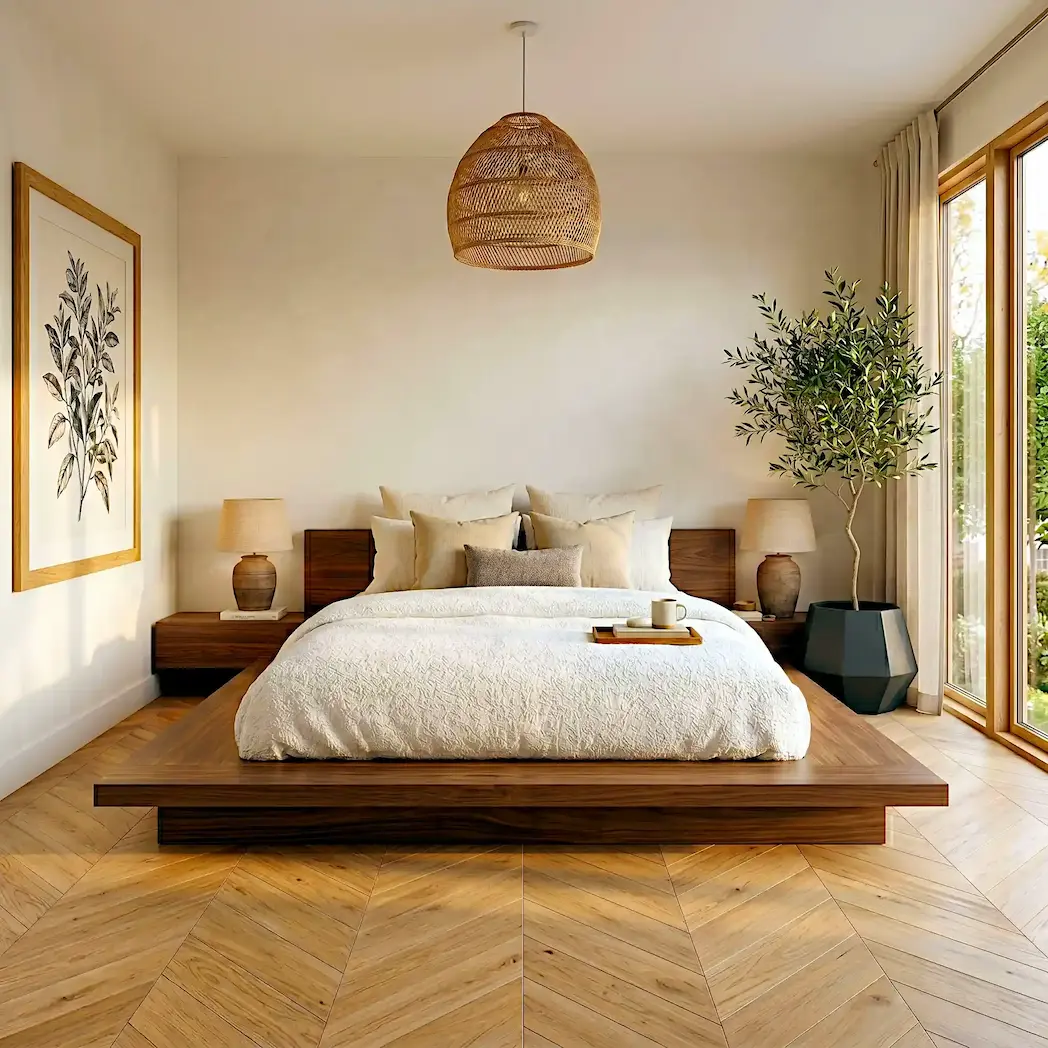
The wide platform bed base that extends as a built-in bedside surface on both sides is one of the most elegant Japandi details possible. It eliminates separate nightstands, keeps the floor cleaner, and gives the room a genuinely bespoke feel without a complicated renovation.
The rattan woven pendant light above the bed and the olive tree in the terracotta pot in the corner bring organic energy to what could otherwise feel too polished. Balance between refinement and nature is the essence of this particular design.
What to buy for this look:
- Wide platform bed with extended base surround
- Thick boucle duvet cover in cream
- Rattan statement pendant light
- Olive tree in large terracotta planter
- Botanical print in wide natural wood frame
Design 15: Blush and Birch
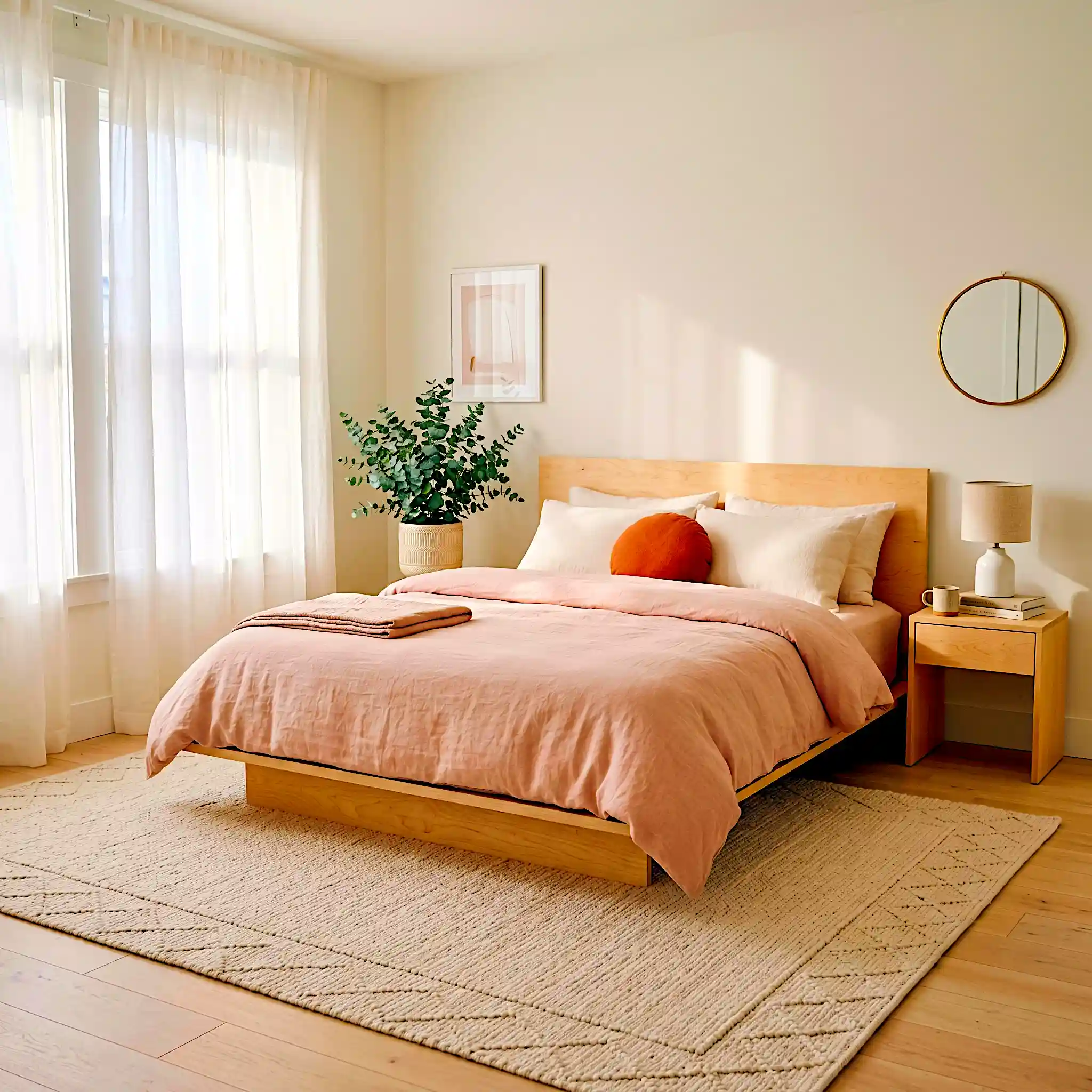
Blush pink sits beautifully within the Japandi palette when it is soft enough to read as a warm neutral rather than a bold color statement. This design uses a soft blush linen duvet against birch wood furniture and warm white walls. The result feels feminine but never overdressed.
The terracotta accent cushion ties the blush bedding to the warm wood tones of the birch nightstand and floor. Eucalyptus in a cream ceramic pot at floor level adds a fresh botanical note without disrupting the warmth of the overall palette.
What to buy for this look:
- Birch platform bed frame
- Soft blush linen duvet cover
- Terracotta accent cushion
- Eucalyptus plant in cream ceramic pot
- Small round mirror above nightstand
Design 16: Low Light Moody
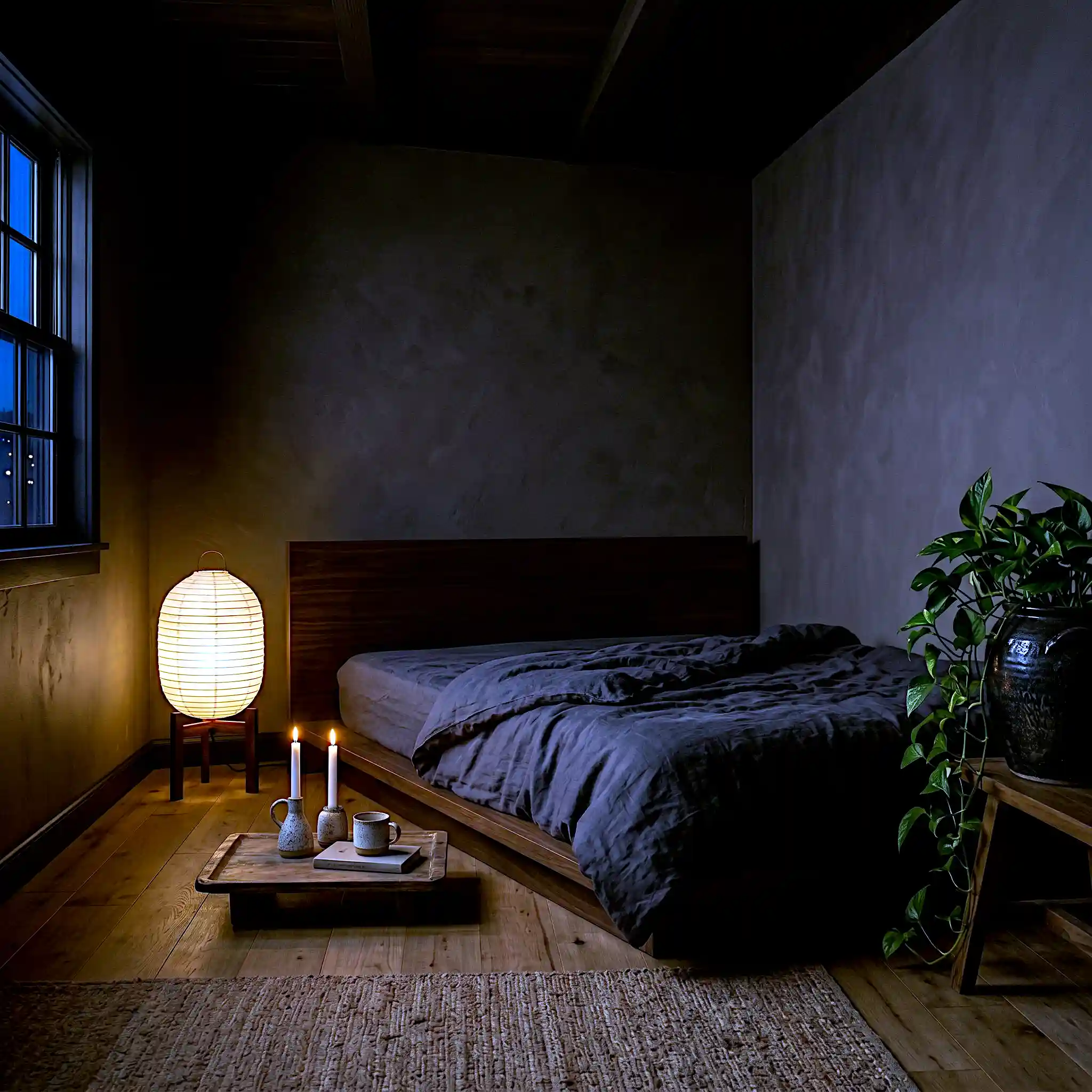
Not every Japandi bedroom needs to be bright and airy. This design uses deep mushroom brown walls, dark walnut furniture, and charcoal bedding to create a bedroom that feels intimate and deeply restful during the evening hours.
The paper lantern floor lamp creates a warm pool of light that makes the room feel like a private sanctuary. Candles in ceramic holders on a low wooden tray add another layer of warm diffused light. This room is designed specifically for people who prioritize sleep quality and evening atmosphere above visual brightness.
What to buy for this look:
- Deep mushroom brown matte wall paint
- Charcoal linen duvet
- Paper lantern floor lamp
- Candle set in ceramic holders on wooden tray
- Large trailing pothos in dark ceramic pot
Design 17: Storage Focused Japandi
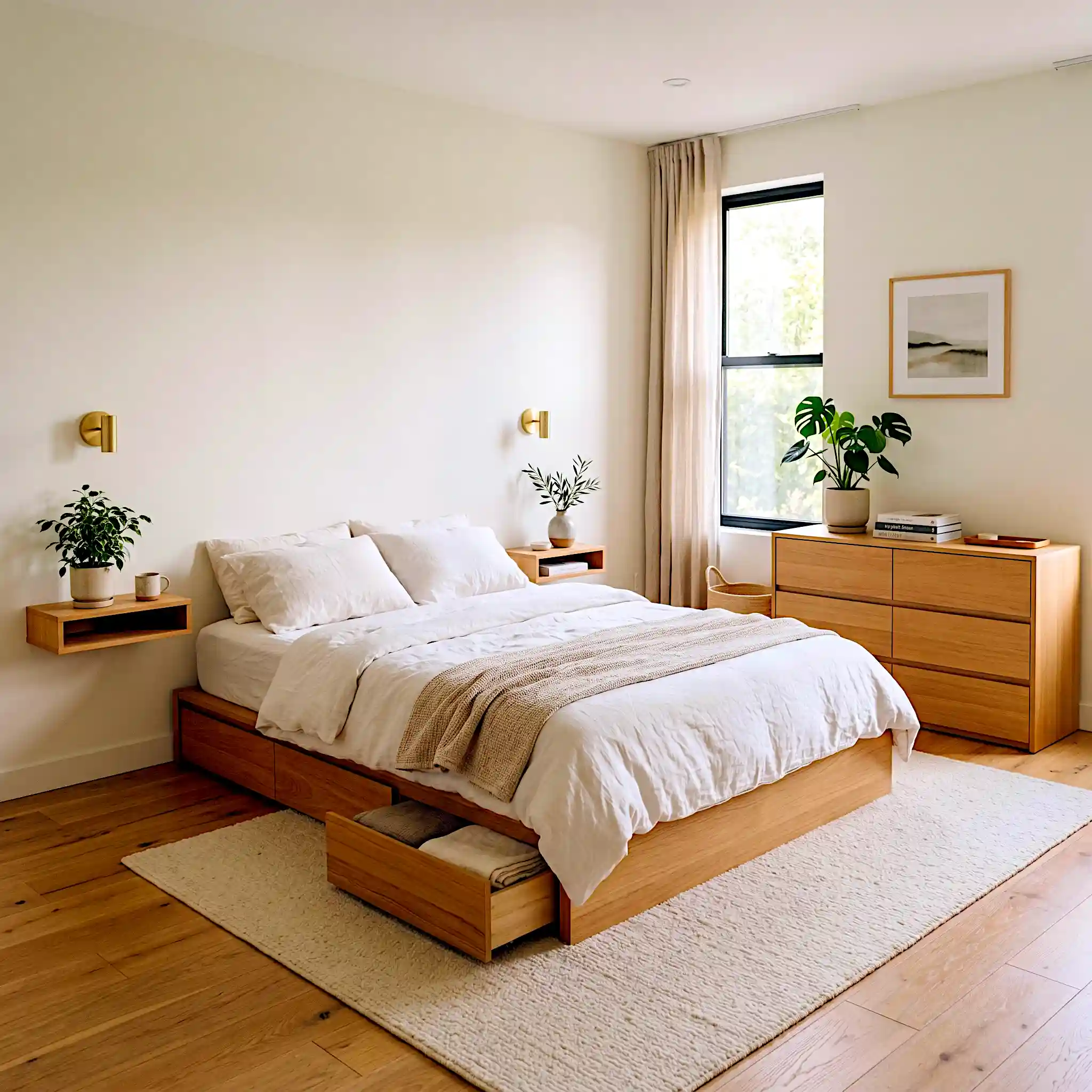
Storage and Japandi aesthetics are not in conflict when storage is handled correctly. This design uses a platform bed with built-in drawer storage, two slim floating wooden shelves at nightstand height, and a low wooden dresser with no visible hardware on the opposite wall.
Hidden storage is a central principle of Japanese interior design. When storage disappears visually, the room feels calm even when it holds a great deal. Every surface in this design has one item maximum. The dresser top holds one medium plant. Each shelf holds two small ceramics and nothing else.
What to buy for this look:
- Platform bed with built-in storage drawers
- Two matching floating oak shelves
- Low four-drawer dresser with push-to-open finish
- Small ceramics for shelf styling, two per shelf
- One medium plant for dresser top
Design 18: Rattan and Linen
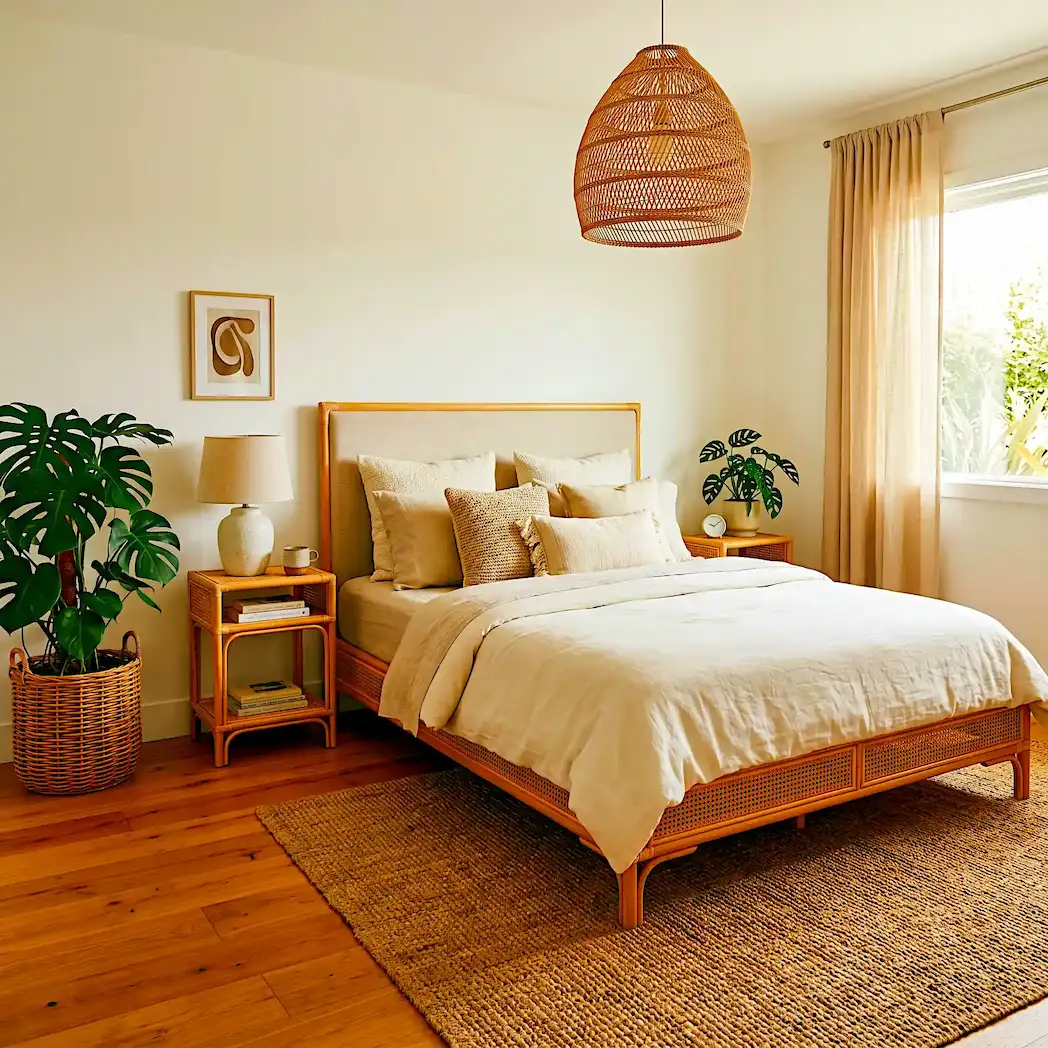
Rattan is perhaps the most distinctly Japandi material available at accessible price points. This design uses rattan in the bed frame, both nightstands, the pendant light, and the basket planter, creating a cohesive material story that holds the room together naturally without any effort.
The linen headboard softens the rattan’s structure and adds comfort to the overall look. A large woven jute rug grounds the entire composition. The monstera in the woven basket in the left corner completes the natural material palette beautifully and adds significant height to the space.
What to buy for this look:
- Rattan bed frame with linen headboard insert
- Pair of slim rattan nightstands
- Large rattan woven pendant light
- Woven jute area rug
- Monstera in large woven basket planter
Large and Master Bedroom Japandi Ideas: 250 Square Feet and Above
Large bedrooms present the opposite challenge from small ones. The risk is not overcrowding but underfilling. A Japandi approach in a large room requires confident placement of larger elements including taller plants, wider rugs, and bigger art to prevent the space from feeling hollow or unfinished.
The key principle for large Japandi bedrooms is anchoring. Every zone needs an anchor element. The bed anchors the sleeping zone. A reading chair or floor cushion arrangement anchors a secondary zone. A statement plant anchors a corner. Without these anchors, large rooms drift toward feeling like a showroom rather than a home.
Here are seven designs built for rooms 250 square feet and above.
Design 19: Master Suite Serenity
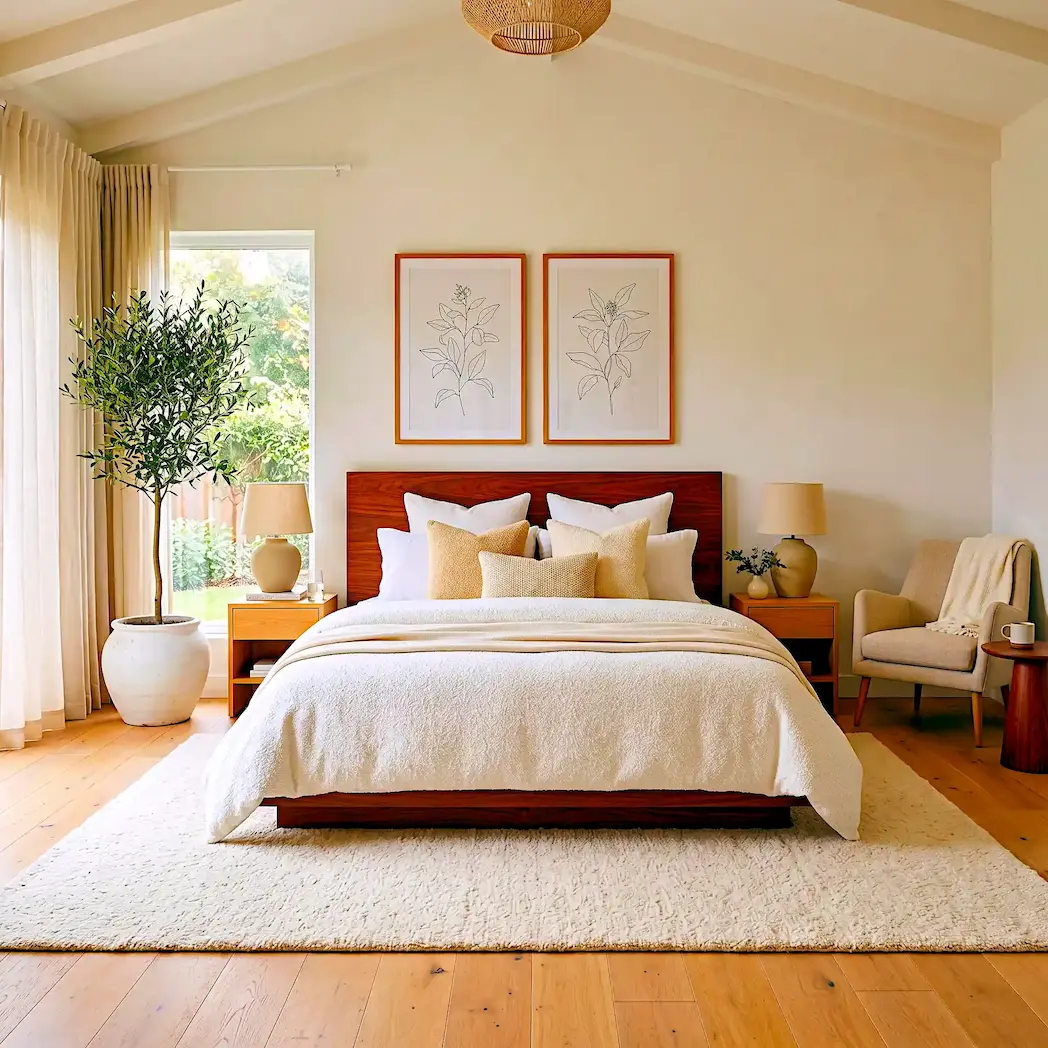
This is the benchmark for a Japandi master bedroom. The king-size low walnut platform bed sits centered on the main wall, flanked by two large slim oak nightstands with matching ceramic statement lamps. The extra-large cream wool rug extends well beyond the bed edges on all sides.
Two large framed botanical prints above the bed anchor the wall without overloading it. The upholstered reading chair in oat linen with slim oak legs beside the window creates a functional secondary moment in the room. Floor-to-ceiling sheer linen curtains draw the eye upward and maximize the sense of ceiling height throughout the space.
What to buy for this look:
- King low platform bed in walnut
- Extra large cream wool rug, minimum 9×12 feet
- Matching pair of large oak nightstands
- Pair of ceramic statement lamps
- Oat linen reading chair with oak legs
- Floor to ceiling sheer linen curtains, three panels
Design 20: Zen Retreat with Sitting Area
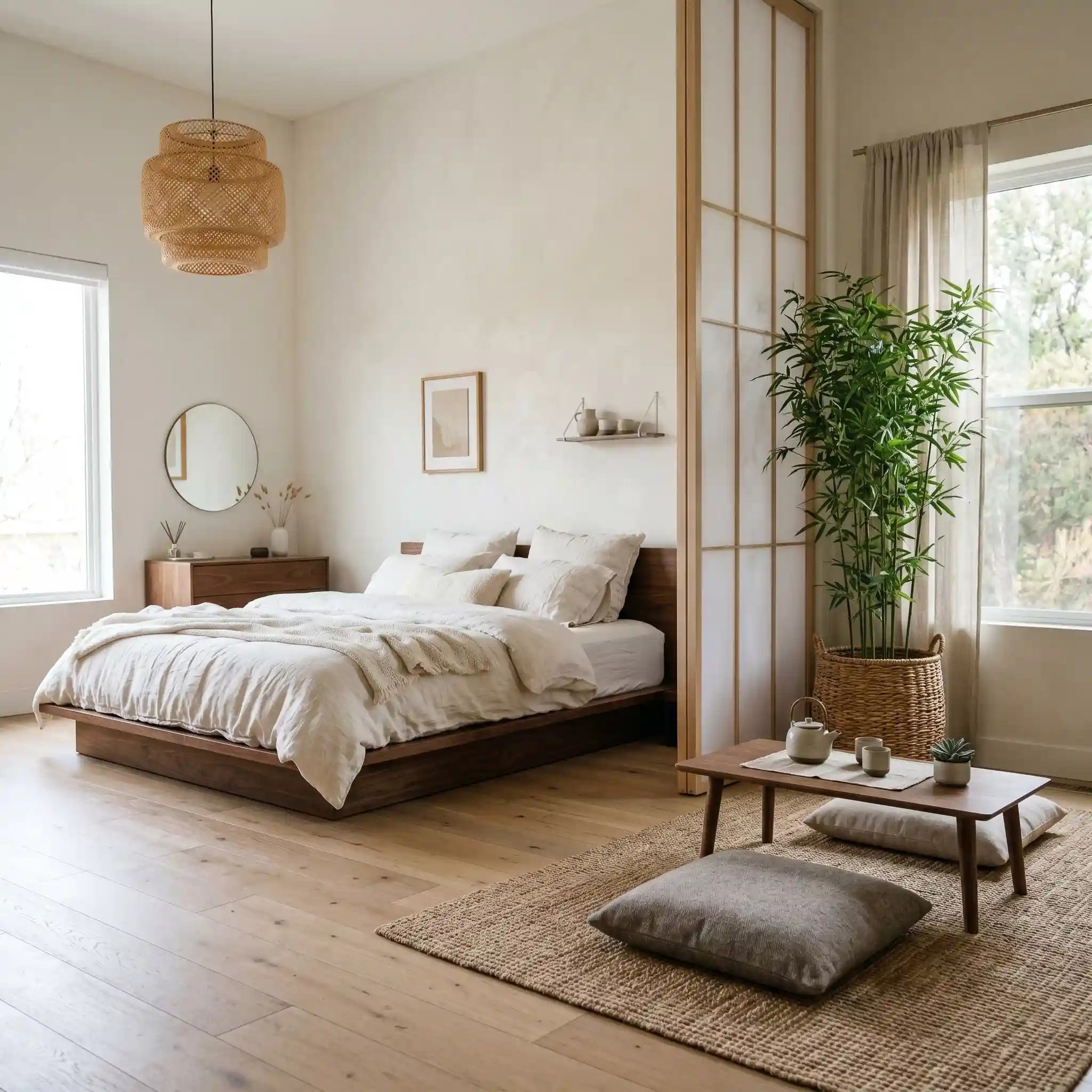
The dedicated meditation or sitting corner is what transforms a large bedroom into a genuine personal retreat. Two low Japanese-style floor cushions in oat and warm gray arranged around a slim chabudai low wooden table create a purposeful secondary zone that reads as entirely intentional.
The shoji screen panel partially dividing the sleeping and sitting zones is a masterful spatial detail. It creates a soft sense of transition between the two areas without closing off either one. The tatami-inspired woven rug under the sitting area reinforces the Japanese influence throughout the overall design.
What to buy for this look:
- Two oversized floor cushions in natural linen
- Chabudai low Japanese wooden table
- Shoji screen panel set, three to four panels
- Tatami-inspired woven area rug for sitting zone
- Tall bamboo plant in large woven basket
Design 21: Dark Dramatic Japandi
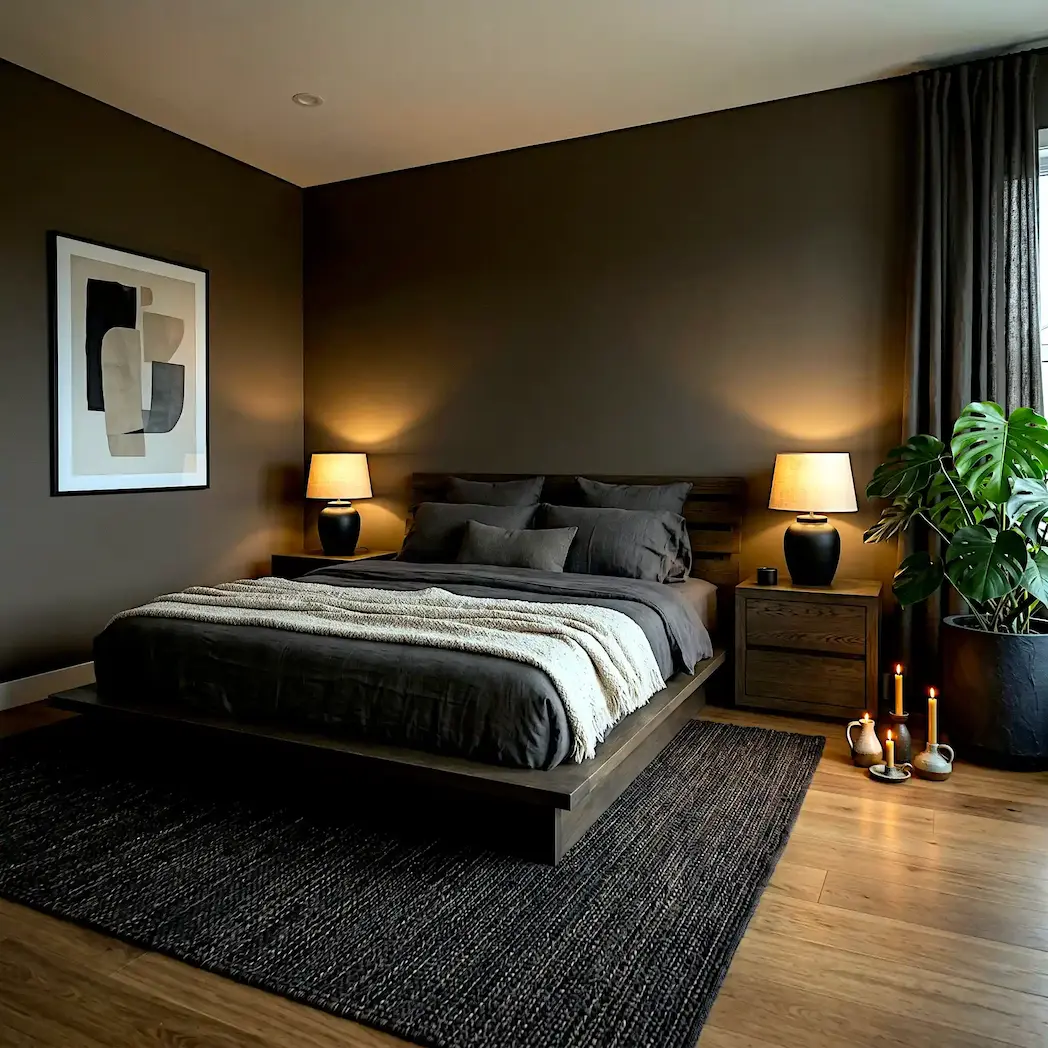
A large bedroom can absorb a dark palette in a way a small room simply cannot. This design uses smoked oak furniture, charcoal bedding, deep mushroom brown walls, and a slate planter to create the most dramatic Japandi design in this entire collection.
The warm cream throw at the foot of the bed and the matte black ceramic lamps on each nightstand maintain the Japandi palette while adding sharp contrast. The very large monstera in the slate corner planter grounds the room and softens the dark materials with its organic shape.
This design is for people who want their bedroom to feel like a sophisticated sanctuary rather than a bright and airy retreat. Both approaches are equally valid expressions of Japandi style.
What to buy for this look:
- King platform bed in smoked dark oak
- Charcoal linen king duvet set
- Deep mushroom brown matte wall paint
- Matching matte black ceramic lamps
- Very large monstera in dark slate planter
- Large dark woven area rug
Design 22: Natural Stone and Wood
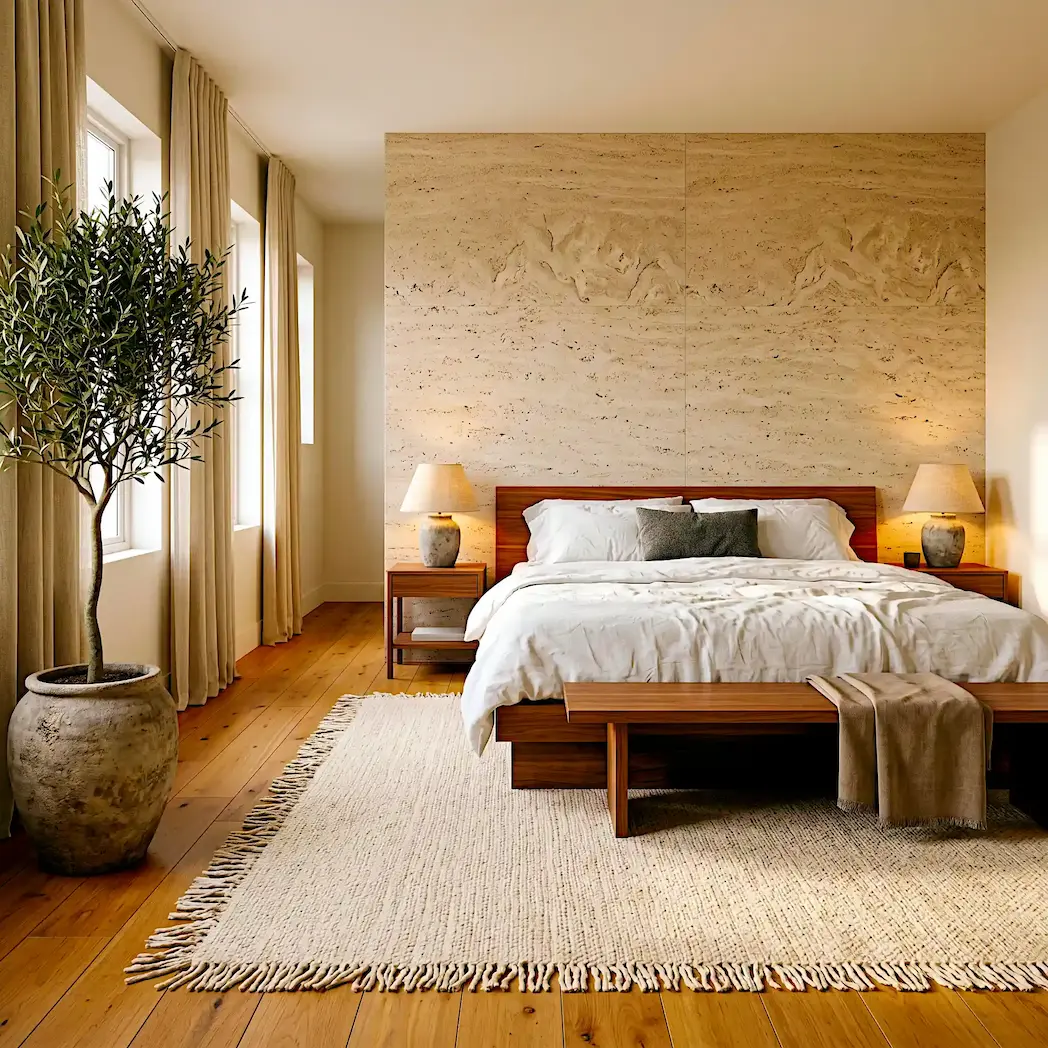
The travertine stone texture feature wall behind the bed is the statement element that elevates this design from beautiful to genuinely luxurious. Natural stone brings a material depth and visual weight that no paint finish can replicate, regardless of how skilled the application.
Wide plank warm oak flooring complements the travertine without competing with it. The stone finish ceramic lamps on the walnut nightstands pick up on the stone texture of the feature wall, creating a material conversation across the entire room. The floor-to-ceiling sheers with afternoon light cast long soft shadows across the stone wall that shift beautifully throughout the day.
What to buy for this look:
- Travertine stone effect wall panels, feature wall only
- Wide plank oak flooring or large format oak-look tiles
- Walnut platform king bed
- Stone finish ceramic table lamps
- Large olive tree in stone ceramic planter
Design 23: Couple's Japandi Retreat
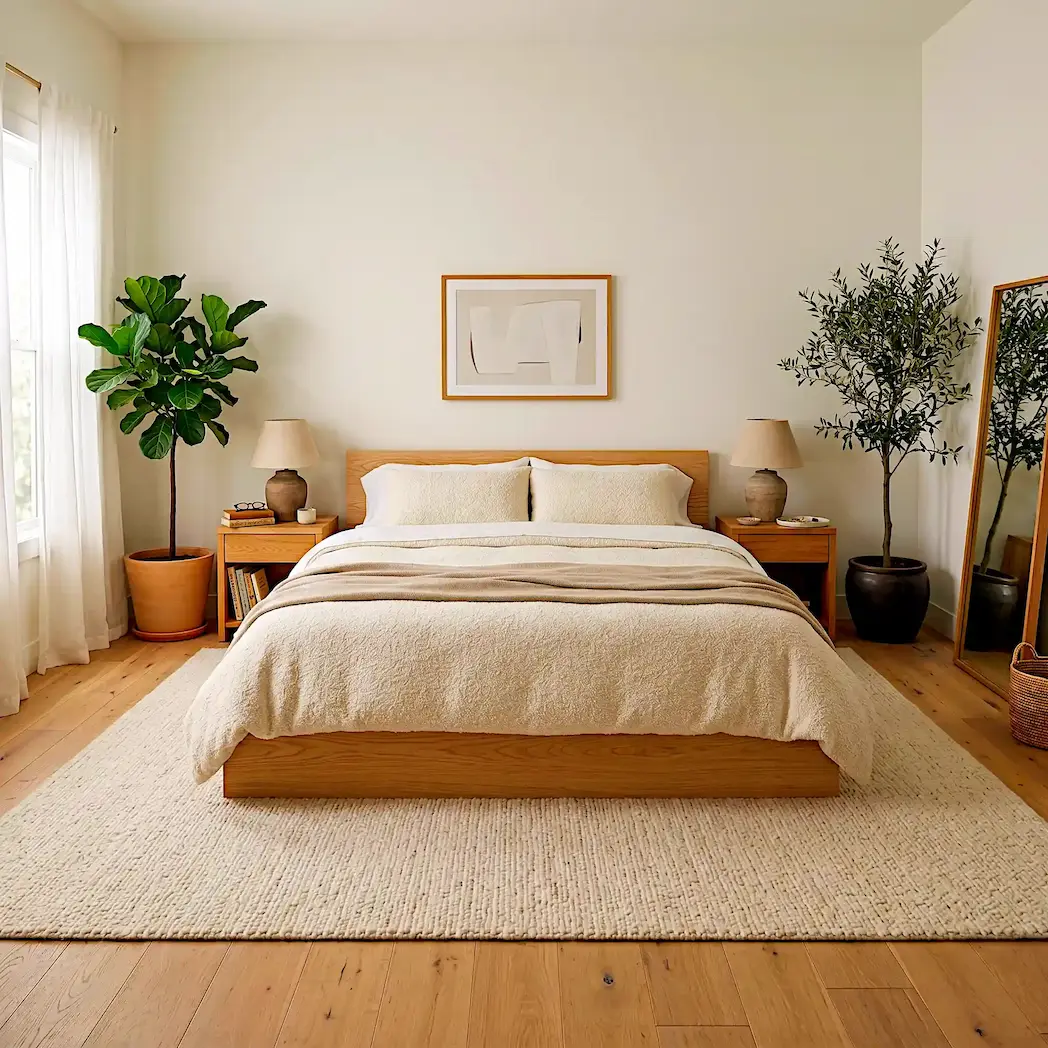
This design is the most livable of the large bedroom collection. It shows how Japandi accommodates two people’s daily routines without losing its aesthetic integrity. The symmetrical nightstand arrangement includes personal touches on each side. Stacked books and reading glasses sit on the left. A small ceramic tray with jewelry sits on the right. These small details make the room feel inhabited rather than staged.
Two statement plants anchor each far corner. A fiddle leaf fig on one side and an olive tree on the other. A full-length mirror in a thin oak frame leans against one wall. This is a room that two people can genuinely live in while it remains beautiful every single morning.
What to buy for this look:
- Extra wide king platform bed in light ash
- Thick cream boucle king duvet
- Matching oak nightstands with personal items per side
- Full length mirror in thin oak frame, leaning
- Fiddle leaf fig and olive tree, one in each far corner
Design 24: Minimalist Master with Dressing Corner
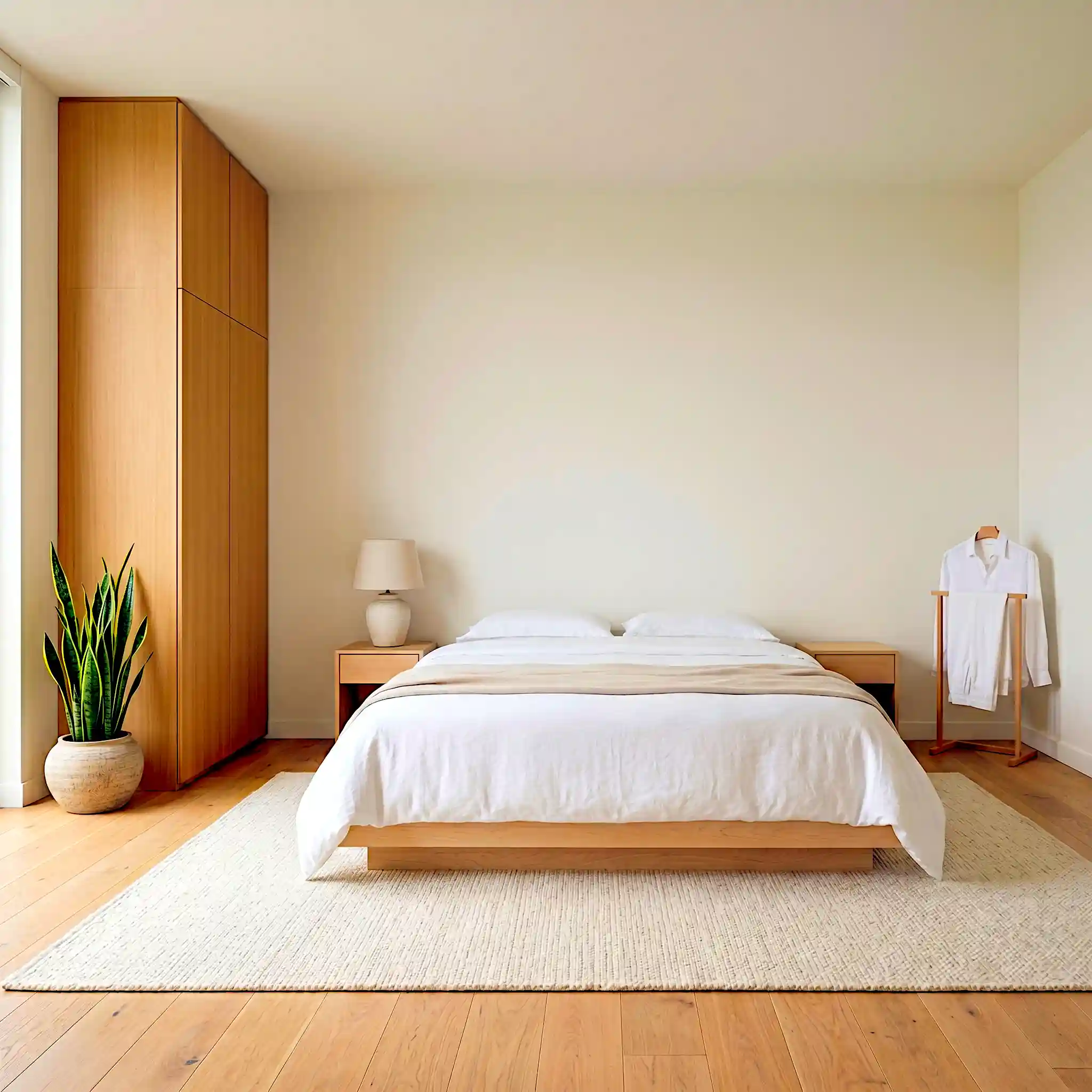
Maximum negative space is the design language here. The floor-to-ceiling built-in wardrobe on one full wall uses push-to-open doors with barely visible seam lines in a matte oak finish. From across the room it reads as a warm oak wall rather than storage furniture, which is exactly the point.
The slim wooden valet stand in the corner with a single folded linen shirt is a detail borrowed from Japanese ryokan hotels. It is entirely practical and entirely beautiful at the same time. This design proves that large rooms do not need large amounts of furniture. They need large amounts of intention.
What to buy for this look:
- Floor to ceiling push-to-open wardrobe in matte oak
- Slim wooden valet stand
- White linen bedding with two flat pillows only
- Single ceramic snake plant beside wardrobe
- One ceramic lamp on left nightstand only
Design 25: The Aspirational Japandi
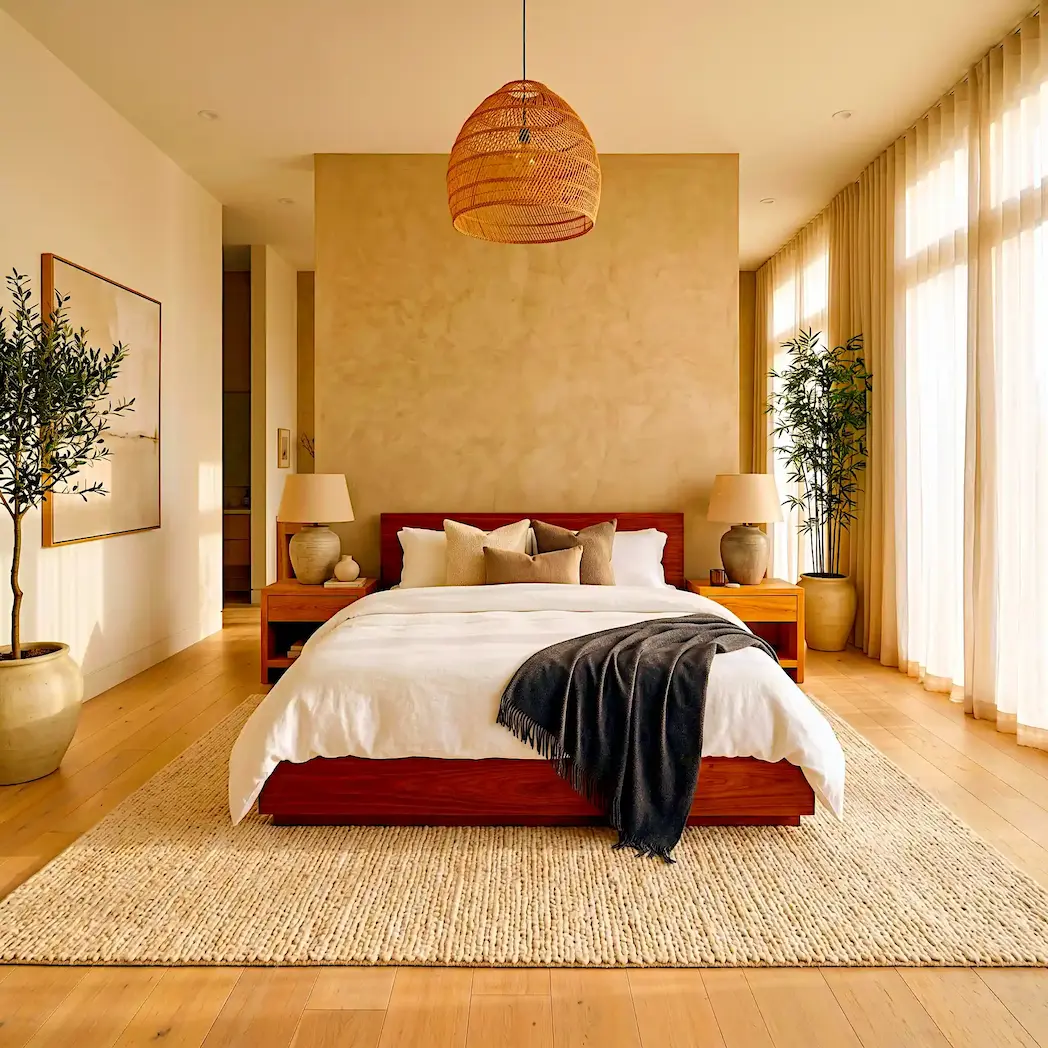
This is the hero design. The room that represents the full potential of Japandi style when space, budget, and design confidence come together.
The extra-wide king platform bed in warm walnut sits against a limewash clay feature wall. An ultra-thick cream wool rug extends across a generous portion of the wide plank oak floor. Two tall statement plants, an olive tree on the left and bamboo on the right, flank the bed in large ceramic planters. A large format abstract art piece on the left wall is the only wall art in the room. Three panels of floor-to-ceiling sheer linen curtains flood the space with morning light and create a dramatic sense of height.
This is the room you build toward. Start with one of the smaller designs in this guide, apply the principles consistently, and work up to this vision over time.
What to buy for this look:
- Extra wide king platform bed in walnut
- Ultra thick cream wool rug, minimum 10×14 feet
- Limewash clay paint for feature wall behind bed
- Olive tree and bamboo in large ceramic planters
- Large format abstract art print in simple frame
- Floor to ceiling sheer linen curtains, three panels
- Rattan statement pendant light above bed
How to Choose the Right Japandi Design for Your Room
You have seen all 25 designs. Now here is how to choose the one that fits your specific situation.
Measure First and Choose Second
The single most important step is measuring your room precisely. Not approximately. Write down your room dimensions and then use this guide.
| Room Size | Recommended Designs |
|---|---|
| Under 120 sq ft | Design 5 or Design 7 |
| 120 to 150 sq ft | Designs 1, 2, 3, 4, 6, or 8 |
| 150 to 200 sq ft | Designs 9, 10, 11, 13, or 15 |
| 200 to 250 sq ft | Designs 12, 14, 16, 17, or 18 |
| 250 to 300 sq ft | Designs 19, 20, or 23 |
| 300 sq ft and above | Designs 21, 22, 24, or 25 |
Choose Your Palette Before You Shop
All 25 designs use warm neutrals, but the specific palette varies between designs. Decide which palette direction feels right for you before buying anything.
| Palette Direction | Best Designs |
|---|---|
| Warm sand and cream | 1, 7, 9, 19 |
| Earth tones and clay | 4, 10, 12, 22 |
| Sage green and oak | 13 |
| Soft blush and birch | 15 |
| Dark and moody | 3, 16, 21 |
| Pure Zen white | 5, 11, 24 |
Start With One Change, Not Ten
The most common Japandi decorating mistake is trying to implement everything at once. Instead, choose one anchor element from your preferred design and start there.
If you love Design 9, start with the cream linen duvet. If you love Design 22, start with the limewash feature wall paint. Let one good decision pull the rest of the room in the right direction gradually. Japandi rewards patience far more than it rewards speed.
The Japandi Shopping Principles That Save You Money
Japandi style has a reputation for being expensive. That reputation is wrong when you understand how the style actually works.
Japandi rewards restraint. You buy fewer things. The things you buy are higher quality and longer lasting. Over time, a Japandi bedroom costs less than a bedroom that gets redecorated seasonally because nothing in a Japandi room goes out of style.
According to research from the American Institute of Architects, natural material interiors consistently report higher long-term homeowner satisfaction scores compared to trend-driven decor approaches. The investment in a quality jute rug or a healthy olive tree pays back in years of visual relevance that fast-fashion decor simply cannot match.
The Japandi approach that saves the most money is straightforward. Rent your accents rather than owning them permanently. Plants, ceramics, dried stems, and throws are inexpensive and easy to refresh. The bed frame and rug are where you invest seriously. Everything else can be updated for under $50 as your taste evolves naturally over time.
Final Thoughts
Every beautiful bedroom in this guide starts with the same foundation. A clear understanding of the space you are actually working with.
Small bedrooms need low furniture, strong single plants, and the confidence to leave walls empty. Medium bedrooms can carry symmetry, reading chairs, and textured accent walls. Large bedrooms need anchor elements, secondary zones, and statement plants to prevent the space from feeling hollow.
Choose the design that matches your room size first. Then match your palette. Then buy your anchor element. Everything else follows naturally from those three decisions.
Japandi is not a trend. It is a philosophy about how a bedroom should make you feel, calm, grounded, and genuinely at rest. When the design matches the room, that feeling comes without any effort at all.
If you found a design in this guide that speaks to your space, save it, measure your room, and start with one piece. That is all it takes to begin.
- Frequently Asked Questions
What size rug do I need for a Japandi bedroom?
Rug size is one of those details people consistently get wrong and it makes a bigger difference than almost any other single decision in a Japandi bedroom. In a small bedroom under 150 square feet a 5×8 foot rug works well but it needs to extend beyond the bed on at least two sides. In a medium bedroom 8×10 is the minimum you should consider. In a large or master bedroom go for 9×12 or bigger because Japandi requires the rug to anchor a significant portion of the floor rather than sitting as a small patch under the bed. The right size rug pulls the entire room together and makes the space feel intentionally designed rather than accidentally assembled.
What is the best bed frame for a Japandi bedroom?
The bed frame is the single most important piece in any Japandi bedroom and the answer is almost always a low platform bed in a natural material. Oak, walnut and ash are the three best wood choices. The headboard should either be completely absent or extremely slim and simple because heavy decorative headboards immediately break the clean visual language that Japandi depends on. The closer the bed sits to the floor the better because this is a core Japanese spatial principle that visually raises the ceiling and makes even a modest room feel more open and calm than it actually is.
Can I do Japandi style in a small bedroom under 150 square feet?
Honestly small bedrooms are where Japandi performs best and that surprises a lot of people. When a room is compact restraint becomes automatic because you simply cannot fill it with unnecessary pieces even if you wanted to. One low platform bed, one large plant, one slim nightstand and clean linen bedding are all you need to create a genuinely beautiful Japandi space in a small room. Designs 1 through 8 in this guide were built specifically for rooms under 150 square feet so you can pick whichever one matches your room dimensions and copy it directly without second guessing yourself.
What plants work best in a Japandi bedroom?
This is probably the most misunderstood element of Japandi decorating and the answer goes against what most people expect. One large statement plant always outperforms three small plants scattered around the room. A single large olive tree or fiddle leaf fig or monstera placed in a corner and given room to breathe does more for a Japandi bedroom than any collection of small pots ever could. That one plant brings height, life and organic energy to the space without creating visual noise. Multiple small plants make a room feel busy and unfocused which is the exact opposite of everything Japandi stands for.
What colors are used in a Japandi bedroom?
Japandi works exclusively in warm neutrals and this is the detail that separates a genuine Japandi bedroom from a room that simply looks sparse. Cream, oat, warm white, clay, sand and soft sage green all belong in the Japandi palette. Cool grays, bright whites and stark blacks do not belong because they push the room toward cold and clinical rather than calm and grounded. A simple rule that always works is this. If the color reminds you of something found in nature under warm sunlight it belongs in a Japandi bedroom. If it feels synthetic or industrial leave it out entirely.
Is Japandi style expensive to achieve?
Japandi has a reputation for being expensive and that reputation is completely undeserved once you understand how the style actually works. Because Japandi is built on restraint you buy fewer things and that alone keeps costs manageable. Design 4 in this guide was built specifically for a budget under 400 dollars and it delivers a genuine Japandi transformation. The most cost effective starting point is replacing your existing duvet cover with a warm linen one which costs between 60 and 90 dollars. Add one large plant in a ceramic pot for around 30 to 50 dollars. Swap your current bulb for a warm 2700K bulb for about 8 dollars. Those three changes alone shift any bedroom toward a real Japandi feel without requiring any significant investment.
What lighting works best in a Japandi bedroom?
Lighting is the most overlooked element in a Japandi bedroom and yet it defines the entire feeling of the space more than almost anything else. Warm 2700K bulbs are non negotiable because they produce the kind of glow that makes a bedroom feel genuinely restful in the evening rather than harsh and overstimulating. Rattan pendant lights above the bed work beautifully because they diffuse light softly and also contribute to the natural material story of the room. Paper lantern floor lamps create a warm pool of ambient light that is perfect for evening wind down. Harsh overhead lighting and cool white bulbs turn a Japandi bedroom cold and clinical immediately so they should be avoided regardless of how carefully everything else in the room has been chosen.
What is the difference between Japandi and minimalism?
The entire difference comes down to one word and that word is warmth. Standard minimalism removes things and the result is often a bare cold room that feels empty rather than peaceful. Japandi does something more sophisticated. It removes the right things and replaces them with carefully chosen natural elements that make the room feel alive and inhabited rather than stripped. Think about the difference between a plain white room with almost nothing in it and a room with one large olive tree in the corner, warm oak floors, a low platform bed and linen bedding that looks genuinely lived in. Both rooms have very little furniture but only one of them actually feels beautiful to spend time in. That distinction is the entire point of Japandi and it is why the style produces results that pure minimalism almost never achieves.
Recent Posts

How to Hang Heavy Art Without Drilling Holes
Beginner Decorating Mistakes That Age a Room Fast